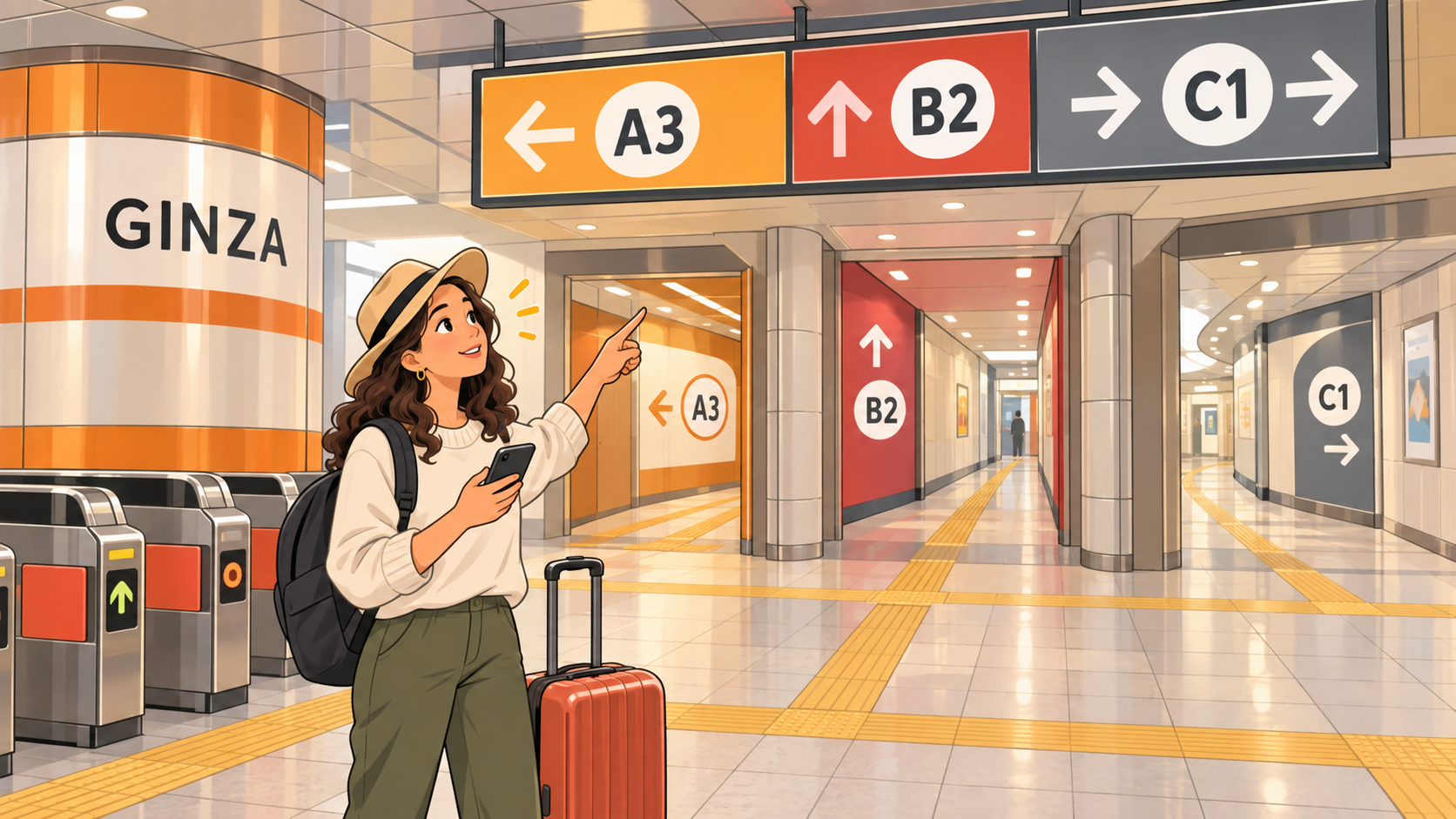
Ginza Station can be confusing when you visit it for the first time.
Three subway lines stop here, and the station has many ticket gates, underground passages, and exits. Even if your destination looks close on Google Maps, choosing the wrong exit can send you in the opposite direction.
Do not worry. Follow these 10 simple steps to find the right subway line and exit.
- 1. Remember That Ginza Station Has Three Subway Lines
- 2. Check the Line Color and Letter
- 3. Do Not Confuse Ginza Station with Ginza-itchome Station
- 4. Check Your Destination Before Looking for an Exit
- 5. Look for the A, B and C Exit Signs
- 6. Choose the Correct Ticket Gate
- 7. Do Not Rely Only on Google Maps Underground
- 8. Follow the Exit Numbers and Arrows
- 9. Ask a Station Employee for Help
- 10. If You Are Still Lost, Go Up to Street Level
- Useful English Phrases
- Final Tips
- Information Note and Disclaimer
1. Remember That Ginza Station Has Three Subway Lines
Ginza Station is served by three Tokyo Metro lines:
- 🟠 Ginza Line — G09
- 🔴 Marunouchi Line — M16
- ⚪ Hibiya Line — H09
First, check which line you need.
Although all three lines use the name “Ginza Station,” their platforms and ticket gates are in different parts of the station.
2. Check the Line Color and Letter
Every Tokyo Metro line has its own color and letter.
At Ginza Station, look for:
- Orange and G for the Ginza Line
- Red and M for the Marunouchi Line
- Silver and H for the Hibiya Line
You do not need to read Japanese. Follow the correct color, letter, and station number.
3. Do Not Confuse Ginza Station with Ginza-itchome Station
Ginza Station and Ginza-itchome Station have similar names, but they are different stations.
- Ginza Station: Ginza, Marunouchi and Hibiya lines
- Ginza-itchome Station: Yurakucho Line, Y19
The two stations are close to each other, so check the full station name before starting your journey.
When using Google Maps, make sure it shows “Ginza Station” and not “Ginza-itchome Station.”
4. Check Your Destination Before Looking for an Exit
Before choosing an exit, check the exact name and address of your destination.
A hotel, department store, restaurant, or shop may list the nearest exit on its official website.
For example, “three minutes from Ginza Station” is not enough information. Look for directions such as “three minutes from Exit A3.”
Knowing the exit number before you arrive will make the station much easier to navigate.
5. Look for the A, B and C Exit Signs
Ginza Station has many exits beginning with the letters A, B and C.
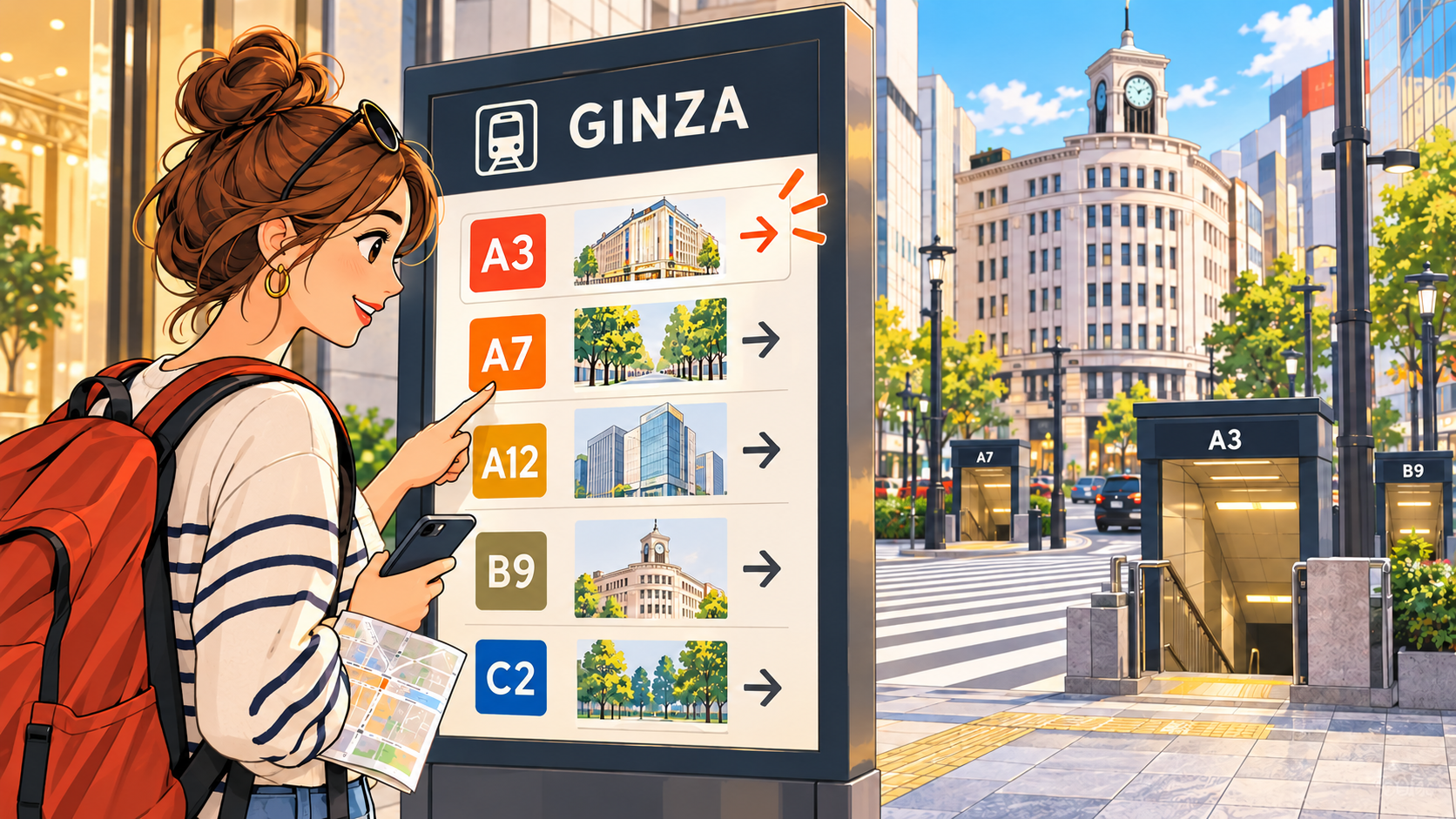
Each letter is followed by a number, such as A3, B2 or C1. Make sure you check both the letter and the number.
Station signs often show nearby buildings, shops, hotels, and intersections. Find your destination on the sign and follow the arrow toward the correct exit.
6. Choose the Correct Ticket Gate
Ginza Station has several ticket gates.
If you use a gate far from your destination, you may have to walk through a long underground passage.
Before passing through a ticket gate, look for your exit number on the overhead signs. If you cannot find it, stop and ask a station employee before leaving the paid area.
7. Do Not Rely Only on Google Maps Underground
Google Maps is helpful, but your location may be inaccurate underground.
The blue location marker may move slowly, point in the wrong direction, or place you on the street above the station.
While you are underground, follow the station signs first. After reaching street level, open Google Maps again to check the rest of your route.
8. Follow the Exit Numbers and Arrows
If you feel lost, stop walking for a moment and look for an exit information sign.
Use this simple order:
- Check the name of your destination.
- Find its nearest exit number.
- Follow the arrow for that exit.
- Check the same exit number again at the next sign.
You do not need to remember the entire route. Follow one sign at a time.
9. Ask a Station Employee for Help
If you still cannot find the correct exit, ask a station employee near a ticket gate.
You can show the destination on your phone and say:
“Which exit should I use?”
You can also ask:
“How can I get to GINZA SIX?”
The station employee can point you toward the correct ticket gate or exit.
10. If You Are Still Lost, Go Up to Street Level
If you keep walking through the same underground passages, use a nearby exit and go up to street level.
It is usually easier to check your position when you can see streets, intersections, and buildings. Open Google Maps again after you are outside.
If you have heavy luggage, use a wheelchair, or are traveling with a stroller, look for an elevator instead of taking the nearest stairs. Some elevators and building-connected exits are available only during certain hours.
Useful English Phrases
Here are three simple phrases you can use at Ginza Station:
“Which exit should I use?”
どの出口を使えばいいですか?
“Where is Exit A3?”
A3出口はどこですか?
“How can I get to this place?”
この場所へはどう行けばいいですか?
Show the destination on your phone while asking. This makes it easier for the station employee to help you.
Final Tips
To avoid getting lost at Ginza Station:
- Check your subway line’s color and letter.
- Do not confuse Ginza with Ginza-itchome.
- Find the nearest exit before arriving.
- Follow station signs while underground.
- Use Google Maps again after reaching street level.
Ginza Station may look complicated, but you can find your way by checking one sign at a time.
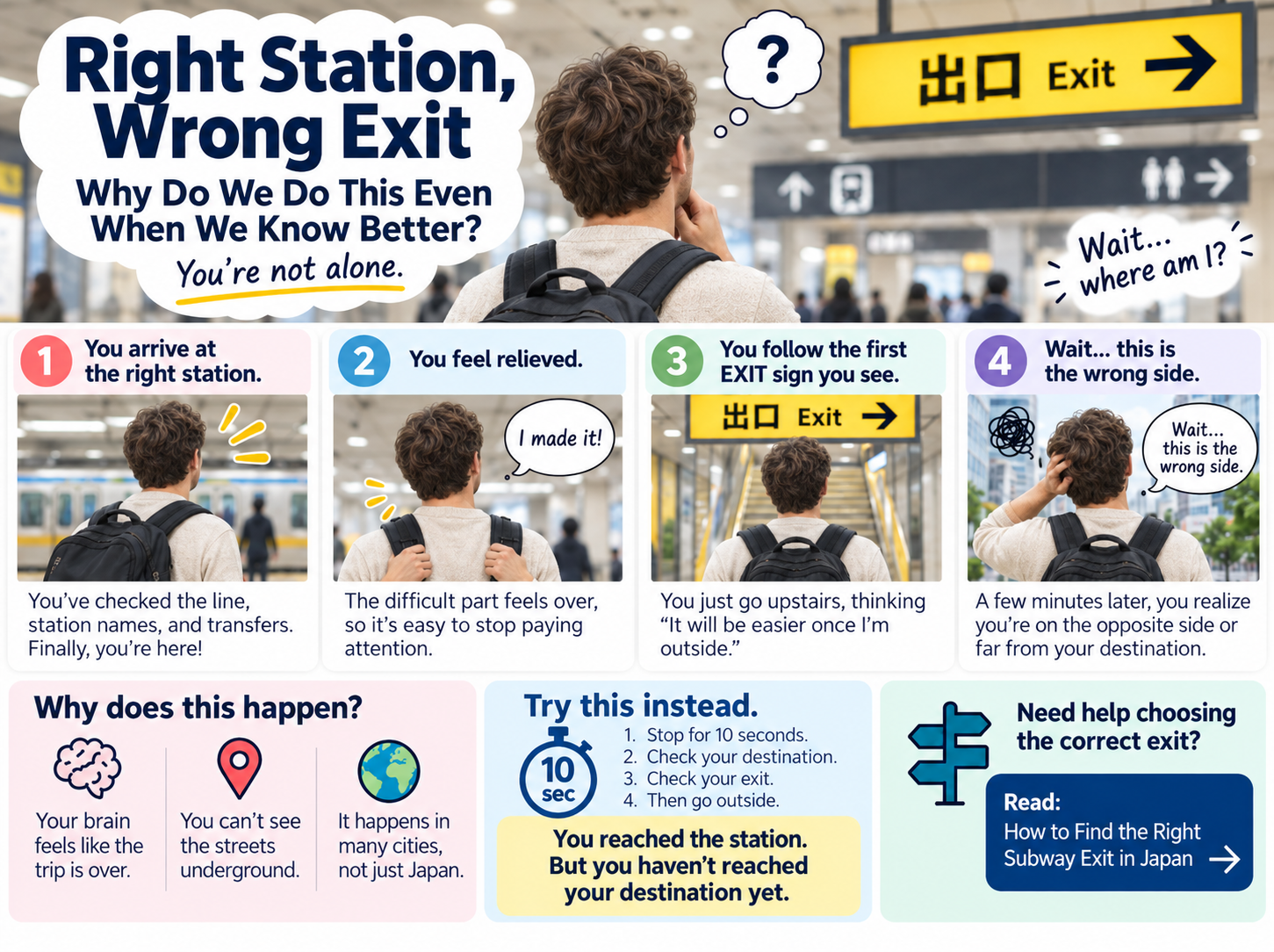
If you become confused, stop for 10 seconds.
Check your destination. Check your exit number. Then follow the arrows.
Not sure which exit is closest to your destination? Check our Ginza Station Exit Guide
Not sure which Ginza-area station to use? Read our guide to Ginza, Ginza-itchome and Higashi-ginza stations.
Information Note and Disclaimer
Information based on available sources as of October 2026.
Station layouts, ticket gates, exit numbers, underground passages, and walking routes may change due to construction, maintenance, or temporary closures.
Always follow current station signs and check the latest official Tokyo Metro station information before traveling.
Japan Life Steps is an independent information website and does not guarantee station access routes or facilities.
コメント