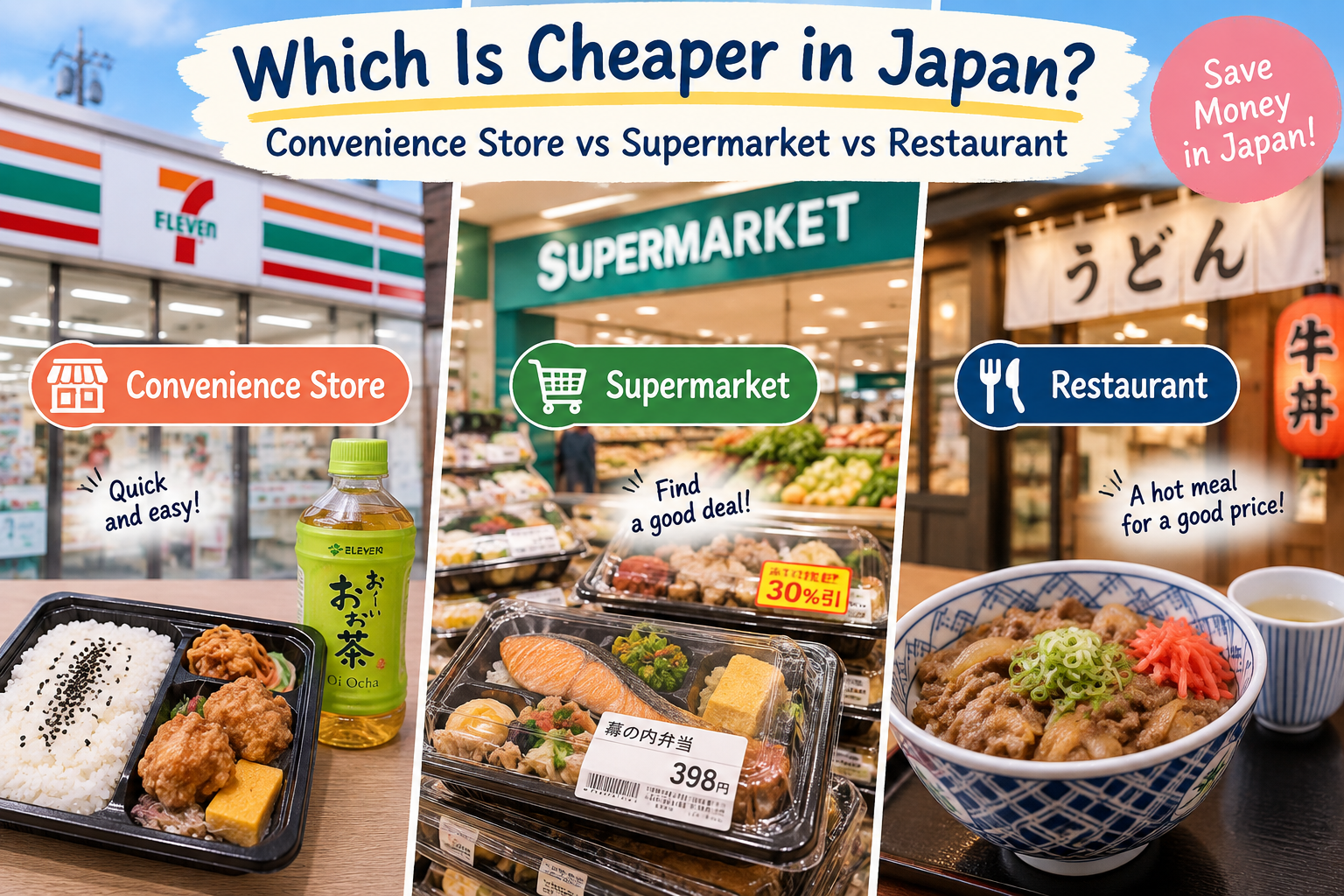
If you want to save money on food in Japan, you might think that convenience stores are always the cheapest option.But that is not always true.
Supermarket meals can sometimes be cheaper, and if you choose an inexpensive restaurant, eating out can even cost less than buying a full meal at a convenience store.
This can be useful whether you are traveling, studying, working, or living in Japan.
Convenience Stores Are Convenient, but Not Always the Cheapest
Japanese convenience stores sell many ready-to-eat foods, including:
- Bento boxes
- Rice balls
- Sandwiches
- Noodles
- Salads
- Snacks
A bento may cost around ¥500–¥700.
However, you may also buy a drink.
For example:
Bento: ¥550
Water or tea: ¥150
Total: ¥700
If you also buy a salad, dessert, or snack, the total can quickly become higher.
Convenience stores are extremely useful, but convenient does not always mean cheapest.
Supermarkets Can Be Cheaper
If there is a supermarket nearby, check the prepared-food section.
Japanese supermarkets often sell:
- Bento boxes
- Sushi
- Rice balls
- Fried foods
- Salads
- Noodles
- Side dishes
Depending on what you choose, supermarket food can sometimes be cheaper than convenience-store food.
Look for Discount Stickers
Later in the day, some supermarkets reduce the prices of bento boxes and other prepared foods.
You may see discounts such as:
- 20% off
- 30% off
- 50% off
However, the time and amount of the discount depend on the store and the product.
Do not assume that everything will become half price in the evening.
A Cheap Restaurant Can Sometimes Cost Less
Eating at a restaurant in Japan is not always expensive.
There are many inexpensive places serving foods such as:
- Gyudon (beef bowls)
- Udon
- Soba
If you choose an inexpensive restaurant or menu item, you may be able to get a hot meal for around ¥500.
There is also another important point that is easy to forget:
the cost of your drink.For example, many restaurants provide free water or tea when you dine inside. However, this usually means tap water only. Soft drinks are not free.
Also, be aware that some places do not offer free water: – Cafes where you must order a drink – Restaurants that only serve bottled water – High‑end restaurants where water is treated as a paid item
If you want free water, you can ask for “tap water”. This is the safest phrase and is commonly understood in Japan.
At many restaurants in Japan, water or tea is provided free of charge when you eat inside.
For example, popular budget restaurants like Yoshinoya and Matsuya offer hot meals for around ¥400–¥600. They are fast, safe, and easy for travelers to use.
– Yoshinoya: https://www.yoshinoya.com/en/
– Matsuya: MATSUYA FOODS CO., LTD.
Convenience Store
Bento: ¥550
Drink: ¥150
Total: ¥700
Inexpensive Restaurant
Meal: ¥500
Water: ¥0
Total: ¥500
So, if you choose an inexpensive restaurant, a hot meal with free water or tea can sometimes cost less than buying a meal and a drink at a convenience store.
Of course, this does not mean that all restaurants are cheaper.
Prices depend on the restaurant and what you order.
Which Should You Choose?
There is no single cheapest option every time.
Convenience store
Good when you are in a hurry or want something quick and easy.
Supermarket
Good for inexpensive bento and prepared foods. You may also find discounted food later in the day.
Inexpensive restaurant
Good when you want a hot meal. Gyudon, udon, and soba can sometimes be surprisingly affordable.
The important thing is to compare the total cost of the meal, including drinks.
If You Are Staying in Japan for a While
If you are studying, working, traveling for a longer period, or living in Japan, you can use all three depending on the situation.
For example:
- In a hurry → Convenience store
- Looking for a cheap bento → Supermarket
- Want a hot, inexpensive meal → Gyudon, udon, or soba restaurant
Even small savings each day can make a difference over time.
A Simple Rule to Remember
Convenience stores in Japan are very convenient, but they are not always the cheapest place to eat.
Supermarkets can sometimes be cheaper, especially if you find discounted prepared food.
And if you choose an inexpensive restaurant, free water or tea can sometimes make the total meal cheaper than buying both food and a drink at a convenience store.
Using convenience stores, supermarkets, and inexpensive restaurants depending on the situation can help you keep your food costs down in Japan.
Prices are examples as of September 2026 and may vary by store, location, and product.
コメント