Thinking about renting an apartment in Shinjuku, Tokyo?
If you are used to larger homes, your first apartment viewing in Tokyo might surprise you.
“Wait… is this the entire apartment?”
A small kitchen, a compact bathroom, and barely enough space for a bed and desk.
But how much space can you actually expect if your rental budget is ¥100,000 a month?
Let’s look at apartment sizes, rental prices, and everyday living conditions in Shinjuku Ward.
Important: The ¥100,000 budget and apartment-size examples in this article are for illustration only. They are not actual rental offers, guaranteed prices, or promises that a particular apartment is available.
- 1. Is ¥100,000 Enough to Rent in Shinjuku?
- 2. How Small Could Your Apartment Be?
- 3. What Does a Six-Tatami Room Mean?
- 4. What Is the Difference Between 1R and 1K?
- 5. What Might Surprise You About a Small Japanese Apartment?
- 6. Does ¥100,000 Rent Mean You Pay Only ¥100,000?
- 7. What About Deposits and Other Move-In Costs?
- 8. What Should You Check Before Renting?
- 9. Is a Small Apartment Worth ¥100,000 a Month?
- 10. Japan Life Steps Tip
- Official and Reference Information
- Disclaimer
1. Is ¥100,000 Enough to Rent in Shinjuku?
It is possible to find apartments with advertised rents of ¥100,000 or less in Shinjuku Ward.
However, ¥100,000 is below the area’s estimated average rent for a studio or 1K apartment.
According to LIFULL HOME’S rental market data reviewed in October 2026:
| Apartment Type | Estimated Monthly Rent |
|---|---|
| Studio (1R) | ¥131,500 |
| 1K | ¥131,300 |
| 1DK | ¥168,700 |
| 1LDK | ¥228,100 |
These figures are market estimates based on rental data for properties within a ten-minute walk of stations. They exclude management fees and other charges.
They are not fixed prices.
Actual rents vary depending on the building, apartment size, age, facilities, location, and other conditions.
Source:
LIFULL HOME’S – Shinjuku Ward Rental Market (Japanese)
2. How Small Could Your Apartment Be?
Japanese apartments are often advertised by their total floor area in square meters (m²).
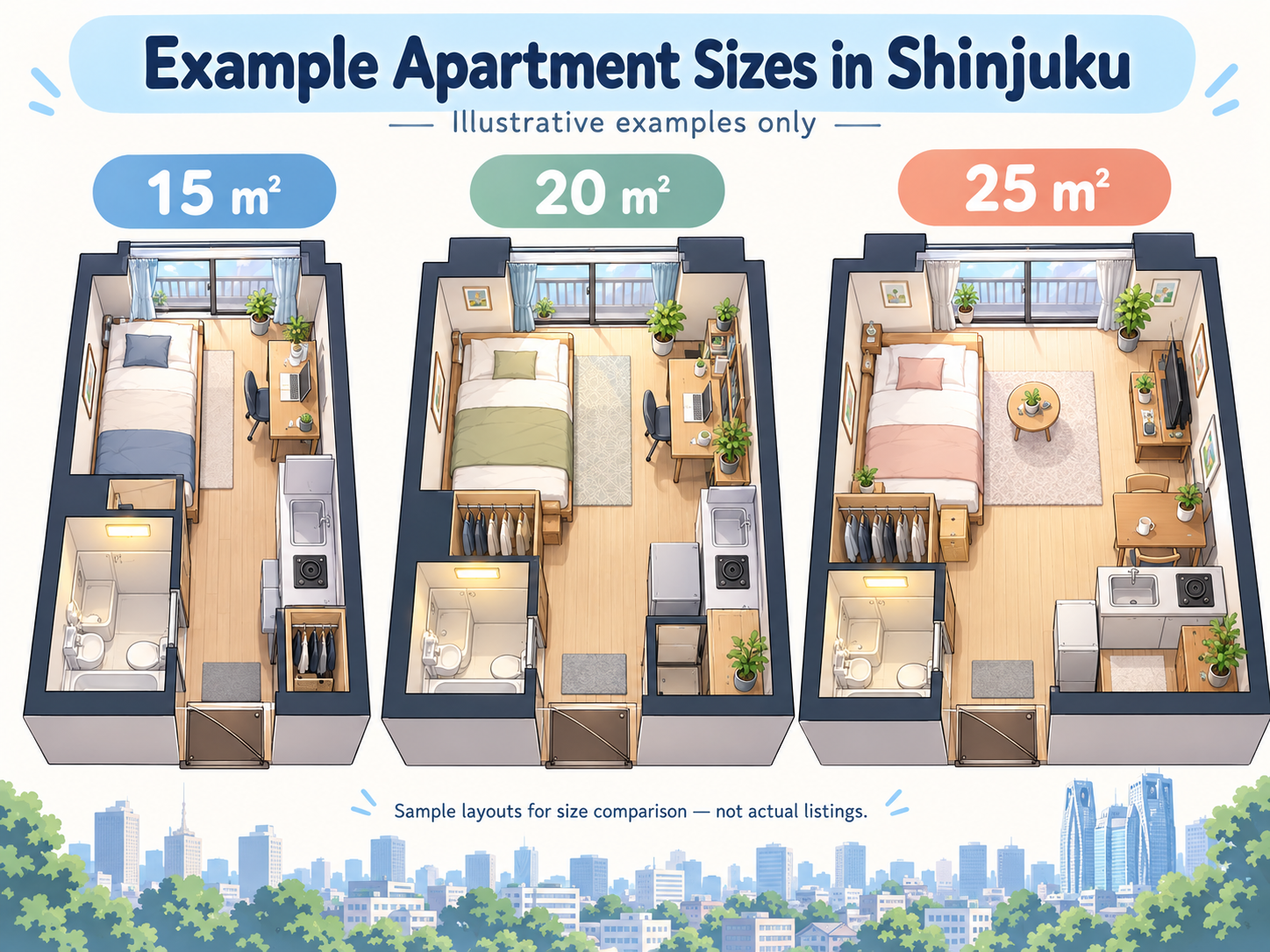
To help you imagine the size, here are three examples.
| Example Apartment Size | Approximate Size in Square Feet |
|---|---|
| 15 m² | 161 sq ft |
| 20 m² | 215 sq ft |
| 25 m² | 269 sq ft |
These are hypothetical size examples, not actual rental listings or apartment sizes guaranteed for ¥100,000.
Imagine a 20 m² apartment.
That space may need to accommodate your sleeping area, kitchen, bathroom, toilet, entrance, and storage.
The entire 20 m² is not necessarily available as living or bedroom space.
If you are accustomed to a larger apartment, the main room may initially feel very small.
However, apartment layouts vary, and a well-designed compact apartment may be more comfortable than its size suggests.
3. What Does a Six-Tatami Room Mean?
Japanese rental advertisements sometimes describe a room as “6 jo” or “6 tatami.”
Jo (畳) is a traditional measurement used to describe room sizes.
Under Japan’s real estate advertising standards, one jo represents at least 1.62 m².
Therefore:
6 jo = approximately 9.72 m² (105 sq ft).
Now imagine putting the following furniture into that room:
- A single bed
- A desk and chair
- A small shelf
- Your suitcase and personal belongings
You may quickly realize how important furniture measurements are.
However, a six-jo bedroom does not mean the entire apartment measures only six jo.
The kitchen, bathroom, and other spaces may be separate.
Always check the total floor area as well as the main room size.
4. What Is the Difference Between 1R and 1K?
Two common types of small apartments in Japan are 1R and 1K.
1R — Studio Apartment
A 1R apartment generally has one main room, with the kitchen area in the same open space.
The bathroom and toilet are usually separate enclosed facilities within the apartment.
1K — One Room With a Separate Kitchen Area
A 1K apartment has a main living room and a kitchen area separated by a door or partition.
However, a 1K is not necessarily larger than a 1R.
A compact 1K may have less usable furniture space than you expect.
The apartment’s total floor area matters more than the layout label alone.
5. What Might Surprise You About a Small Japanese Apartment?
The Kitchen
Some compact apartments have only one cooking burner, a small sink, and limited food preparation space.
If you cook regularly, check the kitchen carefully before applying.
The Bathroom
Some properties have a compact bathroom unit combining a bathtub, sink, and toilet.
Others have separate bathroom and toilet areas.
These facilities differ considerably between properties.
The Closet
Storage space can be surprisingly limited.
Some apartments have small built-in closets, while others have very little storage.
Before signing a lease, think about where you will keep your suitcase, clothes, and seasonal belongings.
Furniture and Appliances
Many ordinary long-term rental apartments in Japan are unfurnished.
A bed, refrigerator, microwave, or washing machine may not be included.
However, furnished rental properties are also available.
Always check what comes with the apartment.
6. Does ¥100,000 Rent Mean You Pay Only ¥100,000?
Not necessarily.
In Japan, some rental listings show the monthly rent separately from the building management fee.
Here is a simple hypothetical example:
| Monthly Expense | Example |
|---|---|
| Advertised rent | ¥100,000 |
| Management fee | ¥5,000 |
| Total housing charge | ¥105,000 |
This is an illustrative calculation, not the cost of an actual property.
Electricity, gas, water, internet, and other personal expenses may also need to be paid separately.
Always ask the agent for the full monthly cost.
7. What About Deposits and Other Move-In Costs?
The initial cost of renting an apartment in Japan can be much higher than one month’s rent.
Depending on the contract, you may need to pay:
- Security deposit (shikikin)
- Key money (reikin)
- Real estate agency fee
- Guarantor company fee
- Insurance
- Advance rent
Shinjuku City’s guidance for foreign residents recommends preparing approximately five to six months’ rent for the initial costs of renting a home.
For a hypothetical apartment costing ¥100,000 per month, this would mean preparing approximately ¥500,000–¥600,000.
This is a general budgeting example, not a mandatory amount or an estimate for a specific apartment.
Some properties require considerably less, particularly when no deposit or key money is charged.
Always request a complete written breakdown before signing.
8. What Should You Check Before Renting?
Before deciding on an apartment, ask yourself:
- Is the main room large enough for my bed and furniture?
- How much usable space will remain?
- Is there enough storage?
- Can I comfortably cook in the kitchen?
- Are furniture and appliances included?
- Is the washing machine space suitable for my machine?
- What is the total monthly payment?
- How much money is required before moving in?
If possible, visit the property before signing the lease.
Photographs taken with wide-angle lenses can make a small room appear larger.
9. Is a Small Apartment Worth ¥100,000 a Month?
There is no single answer.
For someone who wants a spacious home office, a large kitchen, and plenty of storage, a compact apartment may not be suitable.
For someone who prefers a smaller home and values a particular location or convenient transport, it may be an acceptable trade-off.
The important thing is to understand exactly what you are renting.
A small apartment is not automatically a bad apartment. But you should never be surprised by its size after signing the contract.
10. Japan Life Steps Tip
Before renting an apartment in Shinjuku, remember these three things:
Rent: ¥100,000 is only a sample budget. Actual rental prices vary.
Space: Compare the total floor area, room dimensions, and layout before choosing a property.
Costs: Monthly rent and total moving-in costs are different.
An apartment that looks affordable in an advertisement may involve additional payments.
Take your time, compare the details, and ask questions before signing.
Official and Reference Information
- LIFULL HOME’S – Shinjuku Ward Rental Prices
- Shinjuku City – Searching for Housing (English)
- Shinjuku City – Guide to Living in Shinjuku (English)
- Ministry of Land, Infrastructure, Transport and Tourism – Apartment Search Guidebook (English PDF)
Disclaimer
This article is based on information available as of October 2026.
The ¥100,000 monthly rent, example apartment sizes, sample fees, and move-in budget calculations are provided solely to explain how renting in Japan may work.
They do not represent specific available properties, guaranteed rental prices, or actual quotations.
Rental prices, availability, apartment conditions, additional fees, and contract terms vary by property and may change without notice.
Always confirm the latest details directly with the real estate agent or property manager before applying for or renting a property.