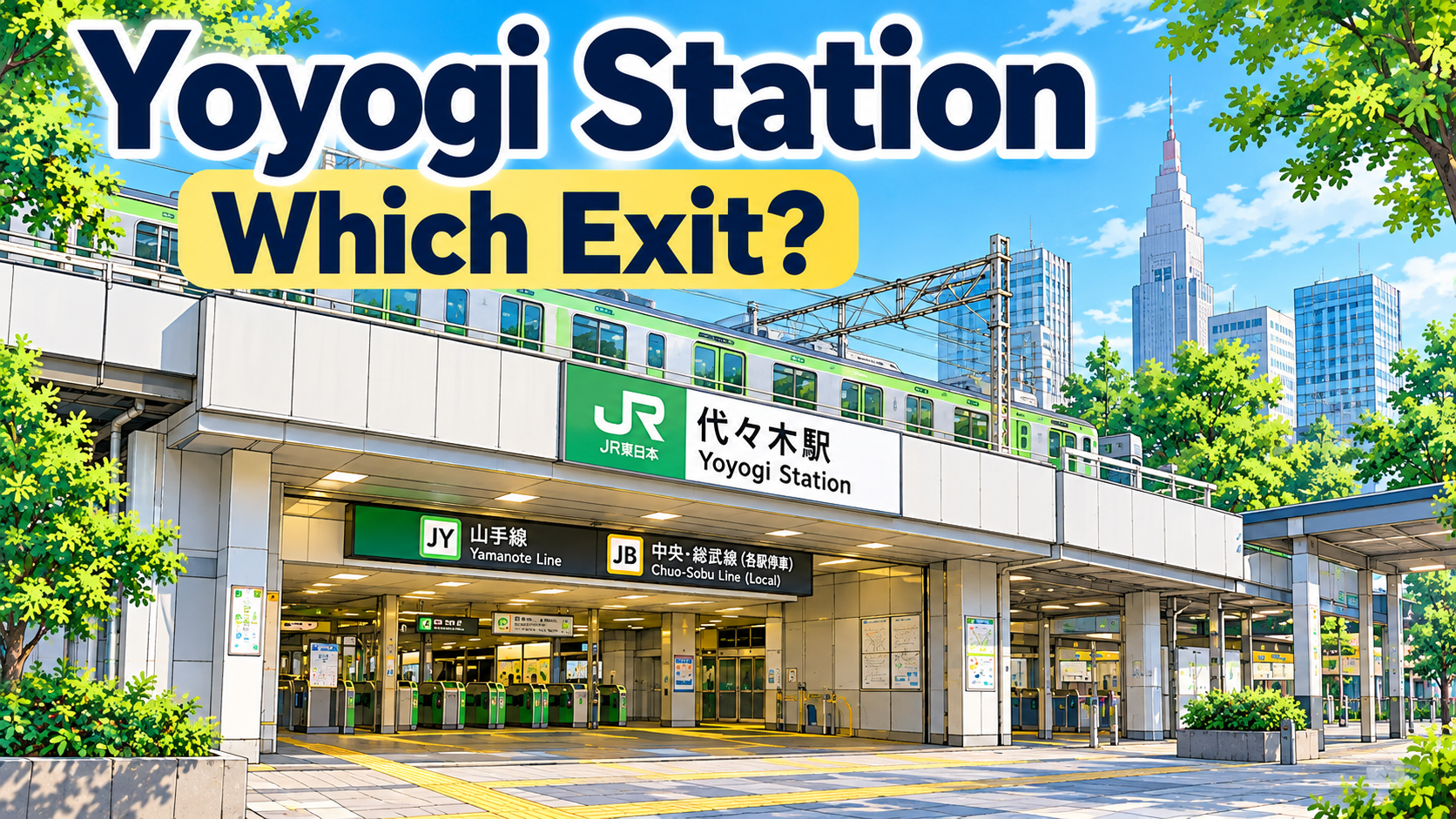
Yoyogi Station is just one stop from Shinjuku on the JR Yamanote Line.
Although it is smaller than Shinjuku Station, choosing the wrong exit can still be confusing, especially when transferring between JR and the Toei Oedo Line.
The most important thing to know is that JR uses named exits — West, North and East — while the Toei Oedo Line uses numbered exits such as A1, A2 and A3.
This guide explains which exit to use, how to change trains and how to reach nearby attractions without unnecessary detours.
- 1. Quick Answer: Which Exit Should You Use?
- 2. JR West Exit — Main Station Area and Oedo Line
- 3. JR North Exit — For the Hospital and Minami-Shinjuku Area
- 4. JR East Exit — Toward Sendagaya
- 5. Toei Oedo Line — Exits A1, A2 and A3
- 6. How to Transfer Between JR and the Toei Oedo Line
- 7. How to Get to Meiji Jingu from Yoyogi Station
- 8. Is Yoyogi Station the Best Station for Yoyogi Park?
- 9. Going to Shinjuku Gyoen National Garden
- 10. Travelling with Luggage, a Stroller or a Wheelchair
- 11. Five Common Mistakes at Yoyogi Station
- 12. Official English Information
- 13. Related Guides on Japan Life Steps
- Final Tip
1. Quick Answer: Which Exit Should You Use?
| Destination | Recommended Exit |
|---|---|
| Yoyogi 1-chome and main shopping streets | JR West Exit |
| Toei Oedo Line near JR West Exit | A2 |
| JR Tokyo General Hospital | JR North Exit / Toei A3 |
| Yoyogi 2-chome and Minami-Shinjuku area | JR North Exit |
| Sendagaya 5-chome area | JR East Exit |
| Meiji Jingu North Entrance | JR West Exit |
| Yoyogi Park | Harajuku or Yoyogi-koen Station is usually better |
| Shinjuku Gyoen Sendagaya Gate | JR Sendagaya Station is usually better |
Important: Toei Oedo Line Exit A1 was closed for construction beginning September 1, 2024. Check the latest official station information before travelling. Exit A2 is the alternative indicated by Toei.
2. JR West Exit — Main Station Area and Oedo Line
The West Exit (西口 / Nishi-guchi) is one of the main entrances to JR Yoyogi Station.
It is convenient for:
- Restaurants and shops around Yoyogi 1-chome
- Tokyo Metropolitan Subway’s Toei Oedo Line
- Walking toward Meiji Jingu’s northern entrance
- Businesses and hotels west of the railway
If you are visiting the main commercial area around Yoyogi Station, the West Exit is usually a convenient choice.
How to Find the West Exit
From the JR platform, follow signs marked:
West Exit (西口)
JR East lists this gate as operating from the first train to the last train.
3. JR North Exit — For the Hospital and Minami-Shinjuku Area
The North Exit (北口 / Kita-guchi) leads toward Yoyogi 2-chome and the southern Shinjuku area.
It is convenient for:
- JR Tokyo General Hospital (JR東京総合病院)
- Yoyogi 2-chome
- The Minami-Shinjuku area
- Toei Oedo Line Exit A3
JR Tokyo General Hospital is approximately five minutes on foot from the North Exit, according to its official access information.
North Exit Opening Hours
JR East lists the North Exit opening hours as:
4:50 AM – 1:00 AM
These hours may change due to railway operations or other circumstances.
If you are travelling very early or late at night, check the latest station information.
4. JR East Exit — Toward Sendagaya
The East Exit (東口 / Higashi-guchi) provides access to streets east of Yoyogi Station.
It is useful for:
- Sendagaya 5-chome and 6-chome
- The area around the NTT Docomo Yoyogi Building
- Buildings east of the railway tracks
Important Information About the East Exit
JR East lists the East Exit as operating from the first train to the last train.
However, the East Exit is normally unstaffed.
A customer-support intercom system is available if assistance is needed.
If you need help from station staff, the West Exit may be more convenient.
5. Toei Oedo Line — Exits A1, A2 and A3
The Toei Oedo Line serves Yoyogi Station as E26.
Its neighboring stations are:
- Kokuritsu-kyogijo (E25)
- Shinjuku (E27)
The Toei Oedo Line operates separately from JR, so its numbered exits should not be confused with JR’s named exits.
Exit A1 — Construction Closure
Toei Transportation announced that Exit A1 would close from September 1, 2024, due to surrounding building reconstruction and station entrance works.
The official announcement directs passengers to use nearby Exit A2 or another available entrance.
The reopening date should be checked through the latest official notices.
Exit A2 — Near JR West Exit
Exit A2 is convenient for:
- JR Yoyogi Station’s West Exit
- Yoyogi 1-chome
- Nearby restaurants and shops
- The main western station area
This is generally a convenient exit when connecting between the Oedo Line and JR’s West Exit.
Exit A3 — Near JR North Exit
Exit A3 is convenient for:
- JR Yoyogi Station’s North Exit
- JR Tokyo General Hospital
- Yoyogi 2-chome
- The Minami-Shinjuku area
Tip: When meeting another person, specify whether you mean JR North Exit or Toei Exit A3.
These are different entrances, although they serve the same general area.
6. How to Transfer Between JR and the Toei Oedo Line
Yoyogi Station has three railway services:
- JR Yamanote Line (JY18)
- JR Chuo–Sobu Line (Local) (JB11)
- Toei Oedo Line (E26)
From JR to the Oedo Line
- Get off the JR train at Yoyogi Station.
- Follow signs toward the Toei Oedo Line.
- Leave the JR ticketed area through the appropriate gate.
- Follow the underground subway entrance signs.
- Enter through the Toei ticket gates.
- Check the train direction before boarding.
The West Exit and nearby A2 entrance are convenient for this transfer.
The North Exit and A3 area provide another connection.
From the Oedo Line to JR
- Get off the Oedo Line train.
- Follow signs for JR Yoyogi Station.
- Head toward the JR West Exit or North Exit area, depending on your route.
- Enter the JR ticket gates.
- Check the destination of your train.
Remember: JR and Toei have separate ticket gates.
If you are changing between the JR Yamanote Line and the JR Chuo–Sobu Line, you can normally remain inside the JR ticketed area.
7. How to Get to Meiji Jingu from Yoyogi Station
Meiji Jingu is one of Tokyo’s best-known Shinto shrines.
It has multiple entrances, and choosing the right one depends on where you are arriving from.
From Yoyogi Station, the North Entrance, also called the Yoyogi Entrance, is convenient.
Recommended Route
- Leave JR Yoyogi Station through the West Exit.
- Walk toward Meiji Jingu’s North Entrance.
- Enter the shrine grounds.
- Follow the paths toward the main shrine buildings.
The North Entrance is approximately five minutes on foot from Yoyogi Station.
Allow at least another ten minutes to reach the main shrine buildings after entering the grounds.
What If You Are Arriving from Harajuku?
If you are coming from Harajuku or Omotesando, the southern entrance to Meiji Jingu is generally more convenient.
Choosing the correct entrance can save unnecessary walking.
For more details:
Meiji Jingu: Which Station and Entrance Should You Use?
8. Is Yoyogi Station the Best Station for Yoyogi Park?
No, not usually.
This is a common point of confusion for visitors.
Yoyogi Station and Yoyogi-koen Station are not the same station.
If your destination is Yoyogi Park, consider:
- JR Harajuku Station
- Tokyo Metro Yoyogi-koen Station (C02)
- Tokyo Metro Meiji-jingumae (Harajuku) Station
According to the park’s official access information, these stations are approximately three minutes on foot from the park.
Yoyogi Station is farther away from the main park area.
Before travelling, check whether your destination is Yoyogi Park, Meiji Jingu or a building in the Yoyogi neighborhood.
These places may require different station exits.
9. Going to Shinjuku Gyoen National Garden
Shinjuku Gyoen has three main public entrances:
- Shinjuku Gate
- Okido Gate
- Sendagaya Gate
Yoyogi Station is not necessarily the most convenient station for visiting the garden.
For Sendagaya Gate
Use JR Sendagaya Station, approximately five minutes on foot from the gate.
For Shinjuku Gate
Consider JR Shinjuku Station or Shinjuku-sanchome Station.
For Okido Gate
Shinjuku-gyoemmae Station on the Tokyo Metro Marunouchi Line is a convenient choice.
Check the entrance you plan to use before choosing your train route.
10. Travelling with Luggage, a Stroller or a Wheelchair
Yoyogi Station has stairs, escalators and elevators, but accessibility varies by route.
If you need step-free access:
- Check the official JR station map before choosing a gate.
- Check the Toei Oedo Line’s elevator locations.
- Do not assume every street exit has an elevator.
- Follow the station’s accessible-route signs.
For passengers with large suitcases, a slightly longer elevator route may be easier than using stairs.
Station staff can help you identify an appropriate route.
11. Five Common Mistakes at Yoyogi Station
Mistake 1: Confusing JR Exits with Oedo Line Exits
JR uses West, North and East Exit names.
The Oedo Line uses A1, A2 and A3.
Always check which railway operator you are using.
Mistake 2: Heading Toward Exit A1 Without Checking
A1 was closed for construction beginning in September 2024.
Check the latest Toei information and use an available alternative.
Mistake 3: Getting Off at Yoyogi Station for Yoyogi Park
Harajuku and Yoyogi-koen Stations are generally more convenient for the main park area.
Mistake 4: Choosing the Wrong Entrance to Meiji Jingu
Yoyogi Station is convenient for the northern entrance.
Harajuku Station is convenient for the southern entrance.
Mistake 5: Using the East Exit for a Destination Near the North Exit
The exits lead to different streets.
Confirm your destination before leaving the station.
12. Official English Information
For the latest station maps, closures and access information, use the official sources below.
JR East — Yoyogi Station Map
View the Official JR Yoyogi Station Map (English)
JR East — Yoyogi Station Timetables
View Official Yoyogi Train Timetables (English)
Toei Transportation — Yoyogi Station (E26)
View the Official Oedo Line Station Map (English)
Meiji Jingu — Shrine Access
View the Official Meiji Jingu Access Guide (English)
Yoyogi Park — Tokyo Official Travel Guide
View Yoyogi Park Visitor Information (English)
Shinjuku Gyoen — Access
View the Official Shinjuku Gyoen Access Guide (English)
13. Related Guides on Japan Life Steps
Planning to explore Meiji Jingu?
Meiji Jingu: Which Station and Entrance Should You Use?
Visiting Tokyo’s Koreatown?
Shin-Okubo Station: Which Exit Should You Use?
Final Tip
Remember these three things at Yoyogi Station:
JR West Exit: Convenient for the main commercial area, Oedo Line connections and Meiji Jingu’s northern entrance.
JR North Exit: Convenient for JR Tokyo General Hospital and the Minami-Shinjuku area.
JR East Exit: Convenient for destinations on the Sendagaya side.
Always check the railway operator, exit name and destination before leaving the station.
Disclaimer (October 2026): This guide is based on official information available as of October 2026. Station layouts, construction closures, ticket gate operating hours, accessibility arrangements and walking routes may change. Please check the latest official information and follow on-site signs before travelling.