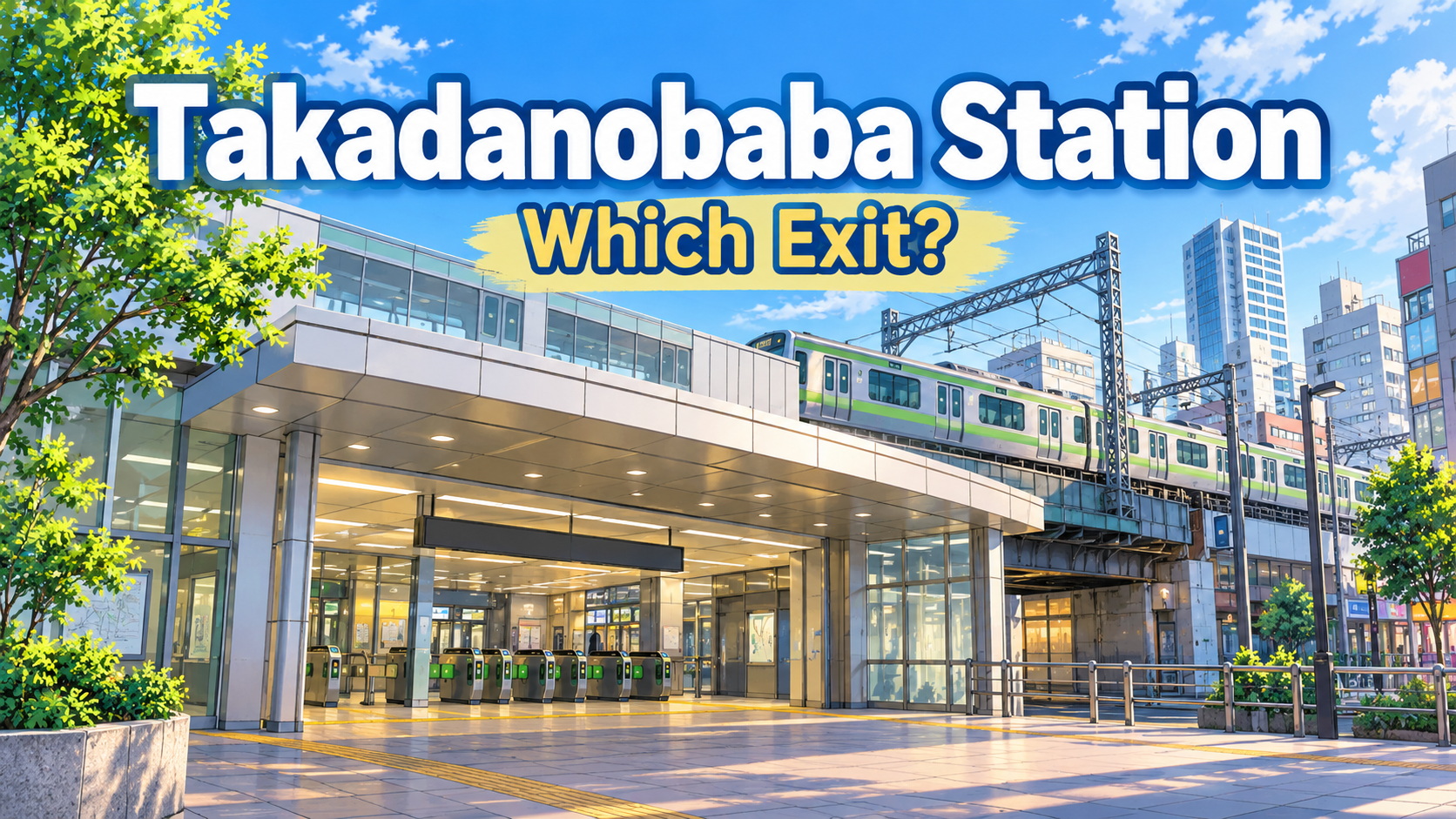
Takadanobaba Station is served by three railway lines in Tokyo:
- JR Yamanote Line (JY15)
- Seibu Shinjuku Line (SS02)
- Tokyo Metro Tozai Line (T03)
The station can be confusing because JR and Seibu Railway both have gates with similar names, while Tokyo Metro uses numbered exits.
If you choose the wrong gate, you may find yourself on a different street from the one you expected.
This guide explains how to choose the correct exit, change trains and reach nearby destinations.
- 1. Quick Answer: Which Exit Should You Use?
- 2. JR Waseda Gate — Best for the Main Station Area
- 3. JR Toyama Gate — What Is It?
- 4. Important: JR Toyama Gate vs. Seibu Toyama Gate
- 5. Changing Between JR and Seibu Railway
- 6. Changing to the Tokyo Metro Tozai Line
- 7. Tokyo Metro Exits 2, 3, 5 and 7
- 8. Going to Waseda University
- 9. Travelling with a Suitcase or Wheelchair
- 10. Five Common Mistakes at Takadanobaba Station
- Mistake 1: Confusing JR and Seibu Toyama Gates
- Mistake 2: Leaving Through Toyama Gate When You Need the Main Station Square
- Mistake 3: Leaving the Station Before Transferring Between JR and Seibu
- Mistake 4: Assuming Waseda University Is Right Outside Waseda Gate
- Mistake 5: Assuming Every Metro Exit Is Always Open
- 11. Official English Station Information
- 12. Related Station Guide
- Final Tip: Remember These Three Things
1. Quick Answer: Which Exit Should You Use?
| Destination | Recommended Gate or Exit |
|---|---|
| Main station square | JR Waseda Gate / Metro Exit 2 |
| BIGBOX Takadanobaba | Metro Exit 3 / Seibu BIGBOX Gate |
| Shops along Waseda-dori | JR Waseda Gate |
| JR Toyama Gate area | JR Toyama Gate |
| Toyama Park | Metro Exit 5 or 7, depending on the destination |
| Waseda University, Waseda Campus | About 20 minutes on foot from Takadanobaba |
| JR to Seibu transfer | Follow JR–Seibu transfer signs |
| Tokyo Metro Tozai Line | Follow signs for the Tozai Line (T03) |
Important: JR’s Waseda Gate and Seibu’s Waseda Gate are separate ticket gates. The same applies to their Toyama Gates.
2. JR Waseda Gate — Best for the Main Station Area
Waseda Gate (早稲田口) is one of the two main JR street-facing gates at Takadanobaba Station.
It is convenient for:
- The main station square
- Waseda-dori
- Nearby shops and restaurants
- Connections to Tokyo Metro
- The BIGBOX area
If you are visiting Takadanobaba for the first time and want to explore the main shopping and restaurant area, Waseda Gate is usually a good choice.
How to find Waseda Gate
From the JR Yamanote Line platform, follow the signs marked Waseda Gate (早稲田口).
Do not confuse the JR gate with the similarly named Seibu Railway gate.
3. JR Toyama Gate — What Is It?
Toyama Gate (戸山口) is the other main JR street-facing gate at Takadanobaba Station.
It is located toward the Shin-Okubo end of the JR platform, away from the main Waseda Gate area.
This gate is useful for destinations on the Toyama Gate side of the station.
However, it is not usually the most convenient choice for the main station square or Tokyo Metro transfers.
How to find JR Toyama Gate
Follow the JR signs marked:
Toyama Gate (戸山口)
JR East lists both Waseda Gate and Toyama Gate as operating from the first train to the last train, although arrangements may change.
Is Toyama Gate the same as Toyama Park?
No.
Toyama Gate is a station gate, while Toyama Park is a public park in the surrounding area.
Do not choose Toyama Gate based only on the name of the park.
Check the exact park entrance or nearby facility before leaving the station.
4. Important: JR Toyama Gate vs. Seibu Toyama Gate
This is one of the most confusing details at Takadanobaba Station.
Both JR East and Seibu Railway have a ticket gate called Toyama Gate.
However, they belong to different railway operators and are not the same ticket gate.
JR Toyama Gate
- Belongs to JR East
- Connects to the JR Yamanote Line
- Located toward the Shin-Okubo end of the JR platform
Seibu Toyama Gate
- Belongs to Seibu Railway
- Connects to the Seibu Shinjuku Line
- Is separate from the JR Toyama Gate
- May have different operating arrangements from JR gates
If you are meeting someone at Toyama Gate, confirm whether they mean the JR gate or the Seibu gate.
Helpful tip: Tell the other person the railway operator as well as the gate name.
For example:
“Let’s meet outside JR Toyama Gate.”
This is clearer than simply saying “Toyama Gate.”
5. Changing Between JR and Seibu Railway
Takadanobaba is an important transfer station between the JR Yamanote Line and the Seibu Shinjuku Line.
You do not necessarily need to leave the station when changing between these two lines.
Dedicated transfer gates connect the JR and Seibu areas.
From JR to Seibu
- Get off the JR Yamanote Line.
- Look for signs indicating the Seibu Shinjuku Line.
- Follow the designated transfer route.
- Pass through the appropriate transfer gate.
- Check the train destination and platform.
Transfer connections are available at different levels of the station, including the first-floor and upper-level areas.
For the simplest journey, follow the current station signs rather than trying to reach a street exit first.
Which direction does the Seibu Shinjuku Line go?
Trains run toward:
- Seibu-Shinjuku
- Tokorozawa and other stations farther west
- Hon-Kawagoe and other destinations, depending on the service
Check the destination and service type before boarding.
6. Changing to the Tokyo Metro Tozai Line
The Tokyo Metro Tozai Line uses the station code T03 for Takadanobaba.
Its two main directions are:
- Nakano
- Nishi-funabashi
If you are travelling to Waseda Station (T04), take a train heading toward Nishi-funabashi.
Waseda is the next station.
From JR to Tokyo Metro
- Get off the JR train.
- Follow signs for Waseda Gate and the Tozai Line.
- Proceed toward the Tokyo Metro entrance.
- Enter through the appropriate Tokyo Metro ticket gates.
- Check your train’s direction before boarding.
Unlike JR and Seibu, Tokyo Metro uses numbered exits for reaching street-level destinations.
7. Tokyo Metro Exits 2, 3, 5 and 7
Tokyo Metro’s official exit information identifies several useful street exits.
Exit 2 — JR and Seibu Waseda Entrances
Recommended for:
- Station square
- JR Waseda Entrance
- Seibu Waseda Entrance
This is a useful exit for connecting to the main station area.
Exit 3 — BIGBOX Takadanobaba
Recommended for:
- BIGBOX Takadanobaba
- Police box
- Station square
- Seibu BIGBOX Entrance
This is a convenient choice if you are visiting BIGBOX.
Exit 5 — Toyama Park Area
Nearby destinations listed by Tokyo Metro include:
- Toyama Park
- Shinjuku Sports Center
- Japan Braille Library
- Shinjuku City Totsuka Branch Office
Exit 7 — Toyama Park and Nishi-waseda Area
Nearby destinations include:
- Toyama Park
- Nishi-waseda Station on the Fukutoshin Line
- Totsuka Daini Elementary School
Important: Tokyo Metro lists Exits 1, 4, 5, 6 and 7 as having restricted opening hours.
Check the latest exit information if you are travelling early in the morning or late at night.
8. Going to Waseda University
Despite its name, Takadanobaba Station’s Waseda Gate is not immediately next to Waseda University’s main campus.
According to Waseda University’s official access information:
| Starting Station | Approximate Walking Time to Waseda Campus |
|---|---|
| JR Takadanobaba Station | 20 minutes |
| Seibu Takadanobaba Station | 20 minutes |
| Tokyo Metro Waseda Station | 5 minutes |
Easier alternative
If you do not want to walk all the way from Takadanobaba:
- Take the Tokyo Metro Tozai Line from Takadanobaba (T03).
- Travel one stop toward Nishi-funabashi.
- Get off at Waseda (T04).
- Walk approximately five minutes to Waseda Campus.
Waseda University has several campuses, so confirm the correct campus before travelling.
9. Travelling with a Suitcase or Wheelchair
Takadanobaba has several levels, stairs, escalators and elevators.
Some routes are easier than others when carrying heavy luggage.
Seibu Railway’s official station information recommends the BIGBOX Gate for wheelchair users because an elevator is available there.
If you need a step-free route, check the latest accessibility information before travelling.
Do not assume every gate provides the same accessible route.
10. Five Common Mistakes at Takadanobaba Station
Mistake 1: Confusing JR and Seibu Toyama Gates
Both operators use the same gate name.
Always confirm which railway company you need.
Mistake 2: Leaving Through Toyama Gate When You Need the Main Station Square
Waseda Gate is usually more convenient for the main station square and nearby shopping area.
Mistake 3: Leaving the Station Before Transferring Between JR and Seibu
Dedicated transfer gates are available.
Follow the transfer signs first.
Mistake 4: Assuming Waseda University Is Right Outside Waseda Gate
Waseda Campus is approximately 20 minutes away on foot.
Mistake 5: Assuming Every Metro Exit Is Always Open
Some numbered Metro exits have limited opening hours.
Always check the latest station information.
11. Official English Station Information
For the latest maps and information, refer to the following official sources.
JR East — Takadanobaba Station Map
View the Official JR East Station Map (English)
Tokyo Metro — Takadanobaba Station (T03)
View Tokyo Metro Exits and Station Information (English)
Seibu Railway — Railway Service
View Seibu Railway Information (English)
This is Seibu Railway’s English railway information page. Detailed station layouts may be provided separately.
Waseda University — Waseda Campus
View Waseda University Access Information (English)
12. Related Station Guide
Planning to explore Tokyo’s Koreatown?
Read our guide:
Shin-Okubo Station: Which Exit Should You Use?
Final Tip: Remember These Three Things
Before leaving Takadanobaba Station:
- Waseda Gate: Usually best for the main station square, shops and Metro connections.
- Toyama Gate: A different side of the station, with separate JR and Seibu gates.
- JR–Seibu Transfers: Follow the dedicated transfer signs instead of immediately leaving the station.
A quick check of the railway operator and gate name can make your visit much easier.
Disclaimer (October 2026): This guide is based on official railway and university information available in 2026. Station layouts, exit opening hours, accessibility arrangements and transfer routes may change. Always follow the latest station signs and consult official information before travelling.