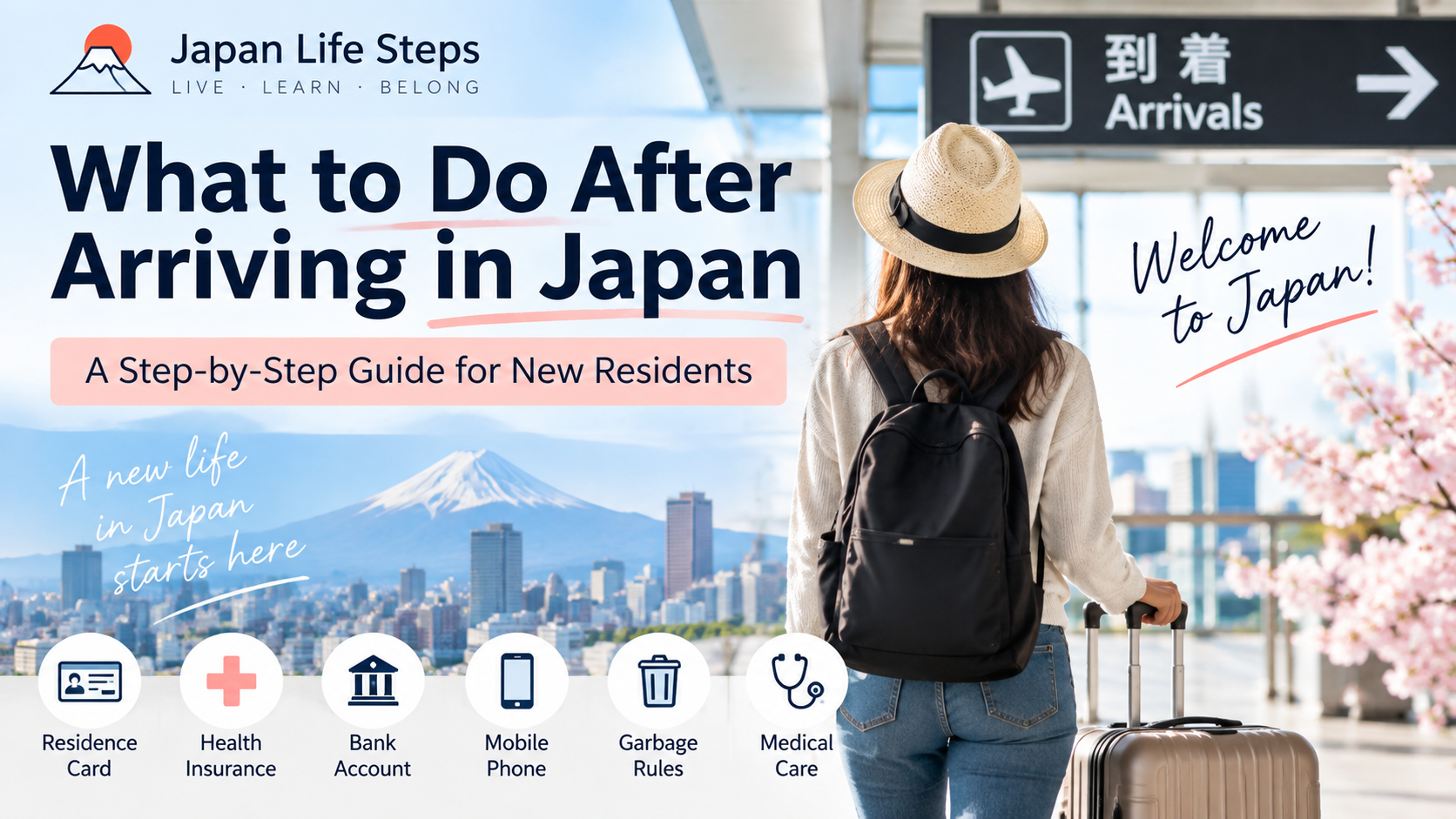
Moving to Japan can be exciting, but the first few days can also feel overwhelming. From registering your address to arranging health insurance and opening a bank account, there are several important things to do after you arrive.
This guide walks you through the first steps for starting your new life in Japan.
- 1. Check Your Residence Card
- 2. Decide Where You Will Live
- 3. Register Your Address
- 4. Arrange Health Insurance
- 5. Get a Japanese Phone Number
- 6. Open a Bank Account
- 7. Learn Your Local Garbage Rules
- 8. Know What to Do If You Get Sick
- 9. Remember Japan’s Emergency Number
- 10. Your First-Weeks Checklist
- Information Note and Disclaimer
1. Check Your Residence Card
If you are entering Japan as a mid- to long-term resident, check the information on your residence card (在留カード / zairyu card).
Keep your residence card safe. You will need it for many procedures in Japan, including registering your address and setting up everyday services.
In some cases, a residence card is not issued at the airport. Instead, your passport may indicate that the card will be issued later.
2. Decide Where You Will Live
Once you have decided on your place of residence in Japan, one of your first important stops should be your local city, ward, town, or village office.
3. Register Your Address
Mid- to long-term residents must notify their local municipal office of their address within 14 days after establishing their place of residence.
Bring your residence card. If your passport states that your residence card will be issued later, bring your passport instead.
Registering your address with the municipality can also satisfy the immigration notification requirement for your place of residence.
4. Arrange Health Insurance
Japan has a public health insurance system.
Depending on your situation, you may be covered by an employer’s health insurance or need to enroll in National Health Insurance.
People who live in Japan and are not covered by another applicable health insurance system generally become eligible for National Health Insurance, although exceptions apply, including certain short-term foreign residents.
If you become eligible for National Health Insurance, the required notification should generally be made within 14 days at your local municipal office.
5. Get a Japanese Phone Number
Having a Japanese phone number can make life much easier. You may need one when opening accounts, arranging deliveries, applying for services, or communicating with your workplace or school.
Compare mobile plans carefully because identification requirements, contract periods, data allowances, and payment methods vary between providers.
6. Open a Bank Account
A Japanese bank account can be useful for receiving your salary, paying rent and utility bills, and setting up automatic payments.
Requirements differ between banks, so check the bank’s current requirements before applying.
We will cover this in detail in a separate Japan Life Steps guide.
7. Learn Your Local Garbage Rules
Garbage disposal rules in Japan are determined locally and can differ significantly from one municipality to another.
You may need to separate burnable garbage, plastics, cans, bottles, PET bottles, and oversized garbage and put them out on specific days.
Ask your local municipal office or check its website for the garbage collection schedule for your neighborhood.
8. Know What to Do If You Get Sick
It is useful to find nearby clinics and hospitals before you actually need them.
Japan has different types of medical facilities, and knowing where to go for a minor illness versus an emergency can save you time and stress.
We will explain how to visit a doctor in Japan, what to bring, how prescriptions work, and how medical bills are paid in a separate guide.
9. Remember Japan’s Emergency Number
Call 119 when you need an ambulance or fire service in an emergency. The dispatcher will ask questions such as your location and what has happened.
10. Your First-Weeks Checklist
After arriving in Japan:
- Check your residence card
- Decide on your place of residence
- Register your address
- Arrange your health insurance
- Get a Japanese phone number
- Open a bank account
- Learn your local garbage rules
- Find nearby medical facilities
- Remember the emergency number 119
Welcome to Japan.
Japan Life Steps will guide you through each part of everyday life in Japan, one step at a time.
Information Note and Disclaimer
This article provides general information about procedures for new residents in Japan.
Administrative requirements, application deadlines, required documents, eligibility conditions, and procedures may change without prior notice. Rules may also differ depending on your municipality and individual circumstances.
Always check the latest information with your local city or ward office and the relevant Japanese government authorities before completing any procedures.
Japan Life Steps is an independent information website and does not provide professional legal, tax, or administrative advice.
The information in this guide is not a substitute for official instructions or advice from qualified professionals.
コメント