You have arrived in Tokyo.
You have your suitcase, your phone, and perhaps a new job or school waiting for you.
But there is one problem.
You haven’t found an apartment yet.
Where can you stay while searching for a permanent home?
Do you need to book an expensive hotel for several weeks? Could a share house or furnished apartment be a better option?
Tokyo offers several types of temporary accommodation for people who need somewhere to stay before moving into a permanent home.
This guide explains your options, approximate costs, and important things to check before booking.
Important: Staying Legally in Japan
This guide is intended for people who are legally permitted to stay in Japan for their planned period.
Booking temporary accommodation or signing a rental contract does not grant permission to remain in Japan beyond your authorized period of stay.
Accommodation providers may also have their own identification, eligibility, and contract requirements.
Always confirm that your accommodation plans comply with your permitted stay and the provider’s conditions.
For official information, visit the Immigration Services Agency of Japan.
- 1. Where Can You Stay Before Finding an Apartment?
- 2. Staying in a Hotel for the First Few Days
- 3. Dormitories: A Lower-Cost Option
- 4. Capsule Hotels: Convenient but Compact
- 5. Share Houses: Your Own Bedroom
- 6. Furnished Apartments and Monthly Rentals
- 7. What If You Find an Apartment After One Week?
- 8. Can You Register Your Address at Temporary Accommodation?
- 9. How Do You Find a Permanent Apartment?
- 10. How Much Money Should You Prepare?
- 11. Japan Life Steps Tip
- Official and Reference Information
- Disclaimer
1. Where Can You Stay Before Finding an Apartment?
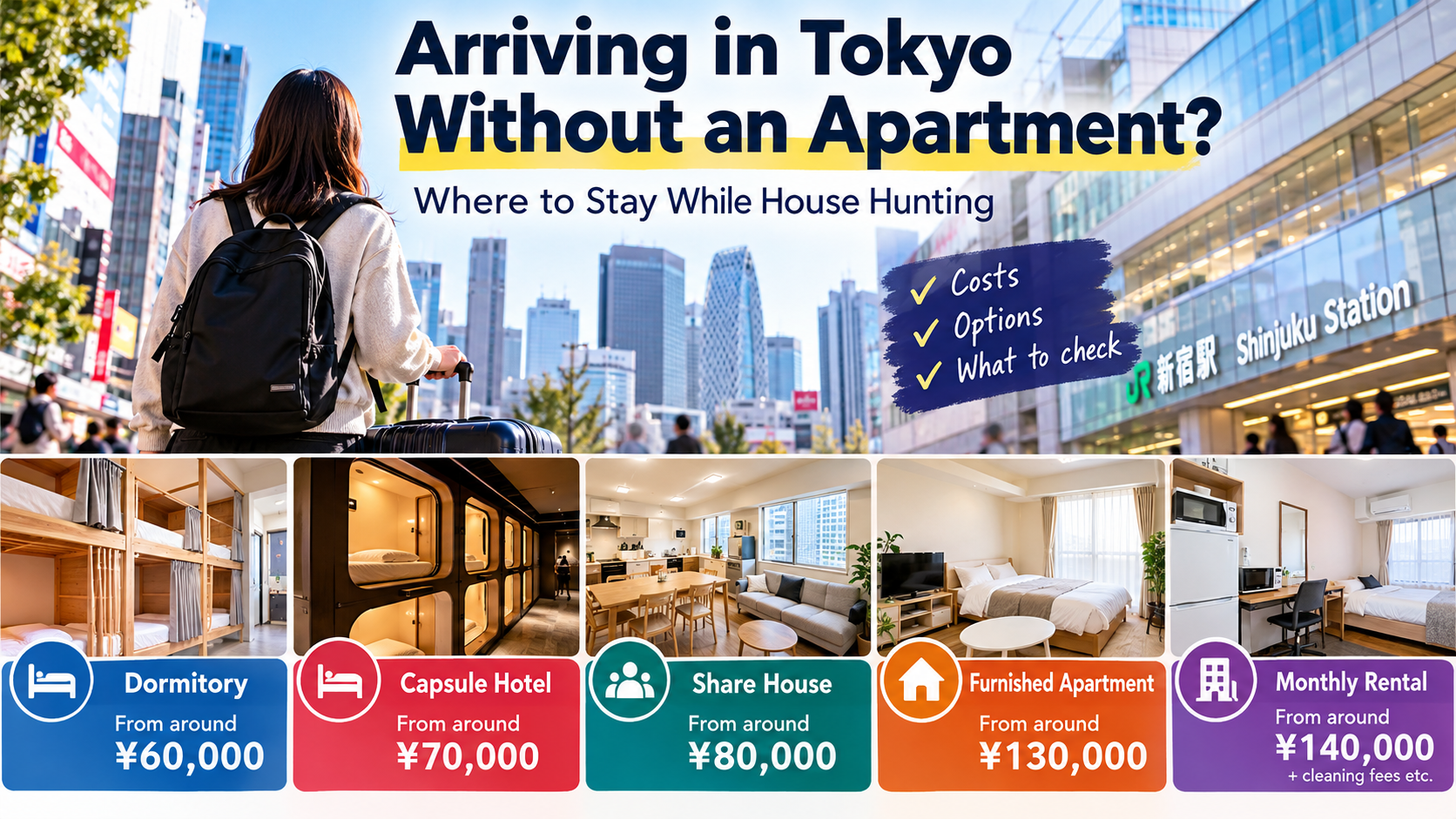
If you have not found a permanent apartment, there are several temporary accommodation options in Tokyo.
| Accommodation Type | Approximate Cost for 30 Days |
|---|---|
| Dormitory (shared bedroom) | From around ¥60,000 |
| Capsule hotel | From around ¥70,000 |
| Share house (private bedroom) | From around ¥80,000 |
| Furnished apartment | From around ¥130,000 |
| Monthly rental apartment | From around ¥140,000, plus possible cleaning fees |
These amounts are approximate examples, not guaranteed prices.
They are based on selected accommodation providers’ published rates reviewed in October 2026.
Actual prices depend on the location, length of stay, availability, contract terms, and additional fees.
Some advertised monthly rates require longer stays. A one-month booking may cost more.
Furnished apartments and monthly rental apartments can also overlap, so compare actual facilities and total costs.
2. Staying in a Hotel for the First Few Days
A hotel can be a simple choice immediately after arriving in Tokyo.
You can leave your luggage, rest after your journey, and begin searching for a more suitable place to stay.
Hotels are particularly useful if you need accommodation for only a few nights.
However, staying in a hotel for several weeks can become expensive.
Before booking, check:
- The total cost of your stay
- Whether you can extend your reservation
- Luggage storage availability
- Laundry facilities
- Cancellation conditions
Tip: Booking your first few nights before arriving in Japan can reduce the pressure of finding somewhere to sleep immediately after landing.
3. Dormitories: A Lower-Cost Option
Dormitories usually provide a bed in a room shared with other residents.
Bathrooms, kitchens, and other facilities may also be shared.
Some accommodation companies offer monthly dormitory stays from approximately ¥60,000.
Advantages
- Relatively affordable
- Furniture is often included
- Shared kitchens may be available
- Suitable for some longer temporary stays
Things to consider
- Limited privacy
- Noise from other residents
- Limited space for luggage
- Shared facilities and house rules
Dormitories may suit people who want to keep temporary accommodation costs low while looking for an apartment.
However, not every dormitory accepts monthly residents, so check the minimum and maximum stay conditions.
4. Capsule Hotels: Convenient but Compact
Capsule hotels provide small individual sleeping spaces, with shared bathrooms and other facilities.
They are often useful for short stays.
Some capsule hotels offer long-stay plans.
For example, one Tokyo capsule hostel has advertised a plan of ¥2,200 per day for stays of at least 28 days.
That is approximately ¥66,000 for 30 days, before any additional charges.
However, this is one provider’s example, not a typical price for every capsule hotel.
Before booking, check:
- Whether a continuous 30-day stay is permitted
- Whether you must check out during the day
- How luggage is stored
- Whether laundry facilities are available
- Whether there are additional charges
Important: Capsule hotels provide sleeping accommodation, but they may not be suitable as a longer-term residential base.
5. Share Houses: Your Own Bedroom
A share house can be a practical choice if you expect your apartment search to take several weeks.
You usually have a private bedroom while sharing facilities with other residents.
Shared facilities may include:
- Kitchen
- Bathroom and toilet
- Washing machine
- Living room
- Internet connection
Some providers offer furnished private bedrooms from approximately ¥75,000 per month.
For initial budgeting, around ¥80,000 or more is a useful starting reference, although actual prices vary.
Why consider a share house?
You may not need to buy furniture immediately.
Some properties include utilities and internet access.
You can also stay while arranging apartment viewings and completing rental procedures.
What should you check?
Ask about the minimum contract period, house rules, additional fees, and early cancellation conditions.
Also confirm whether the property can be used as your residential address when applicable to your circumstances.
6. Furnished Apartments and Monthly Rentals
If you prefer more privacy, a furnished apartment or monthly rental may be a better choice.
Depending on the property, you may have:
- A private sleeping and living area
- A private kitchen
- A private bathroom
- Basic furniture and appliances
- Internet access
- A washing machine or access to laundry facilities
Some furnished apartment providers advertise monthly properties from approximately ¥130,000.
Monthly rental companies may offer similar accommodation, but the total cost for a one-month stay can be higher than the headline monthly rate.
For example, a property advertised at approximately ¥140,000 for a one-month plan may also require a separate cleaning fee.
Always request the total amount for your exact arrival and departure dates.
Do not assume that utilities, cleaning, bedding, or internet access are included unless the contract confirms this.
7. What If You Find an Apartment After One Week?
Imagine that you book accommodation for 30 days.
After just one week, you find a permanent apartment and can move in immediately.
Can you cancel the remaining three weeks and receive a refund?
Not necessarily.
Some providers require payment for a minimum stay and do not refund unused days.
Before booking, ask:
- Can I leave earlier than planned?
- Will unused days be refunded?
- Is there a cancellation fee?
- Can I extend my stay if apartment hunting takes longer?
- Are cleaning or other fees charged when I leave?
A flexible booking may cost more initially but could save money if your plans change.
8. Can You Register Your Address at Temporary Accommodation?
This is especially important for people who are moving to Japan to live, work, or study.
Under Japan’s residence notification rules, mid- to long-term foreign residents generally must register their residential address with the local municipal office within 14 days after establishing their place of residence.
This is not simply a requirement to register within 14 days of arriving in Japan.
Not every hotel, capsule hotel, or temporary accommodation arrangement necessarily qualifies as your residential address.
Whether an address can be registered depends on the actual living arrangement and applicable rules.
Before choosing somewhere to live for an extended period:
- Ask the accommodation provider about residential use
- Check any relevant contract conditions
- Consult the local city or ward office about address registration
- Follow the official reporting requirements that apply to you
Official guidance:
Immigration Services Agency – Guidance for New Arrivals
9. How Do You Find a Permanent Apartment?
Once you have temporary accommodation, you can begin looking for a long-term rental property.
Step 1: Decide your budget
Consider monthly rent, management fees, utilities, and transportation costs.
Step 2: Search for suitable apartments
Compare floor area, location, facilities, and rental conditions.
Step 3: Arrange property viewings
Whenever possible, inspect the actual apartment before applying.
Step 4: Prepare the required documents
Depending on the property, an agent or landlord may request identification, proof of income, and other documents.
Step 5: Review the rental contract
Check the rent, security deposit, key money, agency fee, guarantor company requirements, and other charges.
Step 6: Move into your permanent home
Once your application is approved, the contract is completed, and the property is ready, you can move in.
Complete any required address notification procedures according to your circumstances.
For more information, see the official guide:
Ministry of Land, Infrastructure, Transport and Tourism – Apartment Search Guidebook
10. How Much Money Should You Prepare?
Your temporary accommodation is only one part of your budget.
You may also need money for:
- Food and groceries
- Transportation
- Mobile phone and internet services
- Laundry
- Luggage storage
- Daily necessities
- Apartment deposits and other initial rental costs
- Furniture and household appliances
For example, if your temporary accommodation costs ¥80,000, your total monthly living expenses will be higher once food, transport, and other expenses are included.
You should also keep enough money available for the initial costs of your permanent apartment.
Do not spend your entire housing budget on temporary accommodation.
11. Japan Life Steps Tip
If you are moving to Tokyo and have not yet found a permanent apartment, you do not necessarily need to sign a long-term rental contract immediately.
Consider your expected search period.
A few days: A hotel or other short-stay accommodation may be convenient.
Several weeks: A dormitory, share house, or flexible furnished accommodation may be worth considering.
One month or longer: Compare private furnished apartments and monthly rentals, including all additional fees.
Before making a reservation, confirm that the accommodation provider accepts your intended length and purpose of stay.
Remember:
Finding a home in Japan can take time. Your temporary accommodation should give you enough flexibility to make a careful decision.
Choose a place that suits your budget, privacy needs, and living arrangements rather than simply selecting the lowest advertised price.
Official and Reference Information
The following websites provide information about temporary accommodation and renting in Japan.
Official Government Information
Accommodation Price References
- SAKURA HOUSE – Accommodation Types
- SAKURA HOUSE – Share Houses
- SAKURA HOUSE – Furnished Apartments
- Suzumoriya Capsule Hostel – Official Rates
- Union Monthly – Monthly Rental Example
These accommodation links are provided for price and service comparisons only. Japan Life Steps does not guarantee their availability, suitability, or contract conditions.
Disclaimer
This article is based on publicly available information reviewed in October 2026.
All accommodation prices are approximate examples based on selected advertised rates. They are not market averages, guaranteed minimum prices, confirmed offers, or quotations for specific travel dates.
Actual costs, availability, eligibility, minimum stay requirements, cancellation policies, and contract conditions may vary.
Accommodation reservations and rental contracts do not grant or extend immigration permission.
Residence registration requirements depend on the person’s legal status and actual living arrangements.
Always confirm current accommodation terms directly with the provider and consult official authorities regarding legal stay and residence notification requirements.