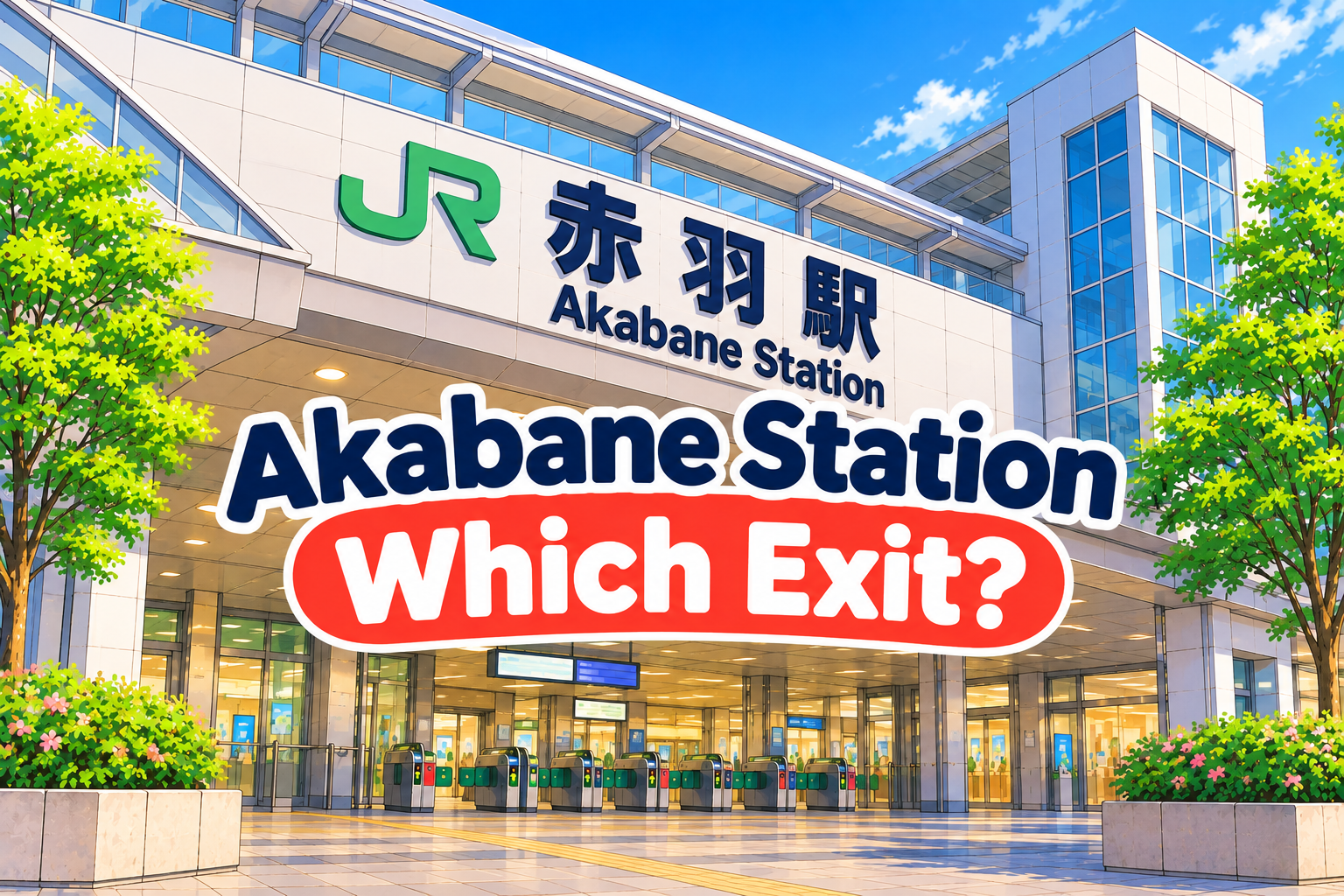
Arrived at Akabane Station in Tokyo and not sure which exit to use?
Akabane is a busy JR railway station connecting Tokyo, Saitama, and destinations farther north.
You may see signs for the North Ticket Gate, South Ticket Gate, East Exit, and West Exit.
These names can be confusing because ticket gates and street exits are not the same thing.
This guide explains which exit to use for shopping streets, local facilities, hotels, and train transfers.
- Quick Answer: Which Exit Should You Use?
- Which Railway Lines Serve Akabane Station?
- North Ticket Gate or South Ticket Gate?
- East Exit: Shopping Streets and Restaurants
- West Exit: Shopping Centers and Supermarkets
- How to Get to Akabane Library
- How to Transfer Between JR Lines at Akabane
- Is Akabane-Iwabuchi the Same Station?
- Traveling With Luggage, a Stroller or a Wheelchair
- Common Mistakes at Akabane Station
- Mistake 1: Confusing North Ticket Gate With East Exit
- Mistake 2: Taking the West Exit for Akabane Ichibangai
- Mistake 3: Taking the East Exit for Akabane Apire
- Mistake 4: Looking for the Namboku Line Inside JR Akabane
- Mistake 5: Leaving the Ticket Gates During a JR Transfer
- Mistake 6: Boarding the Wrong JR Train
- Quick Summary
- Official Information
- Related Guides
- Information Note
Quick Answer: Which Exit Should You Use?
| Destination | Recommended Direction |
|---|---|
| Akabane Ichibangai Shopping Street | East Exit |
| LaLa Garden Shopping Street | East Exit |
| Restaurants and hotels east of the station | East Exit |
| Akabane Apire Shopping Center | West Exit |
| Ito-Yokado Akabane | West Exit |
| West Exit bus and taxi stops | West Exit |
| Akabane Library | East Exit or south-side station entrance |
| Akabane-Iwabuchi Station (Namboku Line) | East Exit, then walk north |
Important: The North and South Ticket Gates are JR ticket gates. The East and West Exits lead to different areas outside the station.
Which Railway Lines Serve Akabane Station?
Akabane Station (赤羽駅) is served by several JR services:
- JR Keihin-Tohoku Line (JK38)
- JR Saikyo Line (JA15)
- JR Utsunomiya Line and Takasaki Line (JU04)
- JR Shonan-Shinjuku Line (JS22)
These lines provide connections toward:
- Ikebukuro
- Shinjuku
- Shibuya
- Ueno
- Tokyo
- Omiya
- Yokohama
Different services use different platforms and routes.
Important: Akabane Station does not have a Tokyo Metro subway platform.
The nearby Tokyo Metro station is Akabane-Iwabuchi, which is a separate station.
North Ticket Gate or South Ticket Gate?
Akabane Station has two main JR ticket gates:
- North Ticket Gate (北改札口)
- South Ticket Gate (南改札口)
Both are below the elevated railway platforms.
North Ticket Gate
The North Ticket Gate connects to the station’s main east-west public passage.
After leaving the North Ticket Gate:
- Follow the East Exit (東口) signs for Akabane Ichibangai, LaLa Garden, and eastern shopping areas.
- Follow the West Exit (西口) signs for Akabane Apire, Ito-Yokado, and western shopping areas.
The public passage connects the two sides of the station without requiring you to enter the JR ticket gates.
If you choose the wrong side, use the public passage to reach the opposite side.
South Ticket Gate
The South Ticket Gate serves the southern part of Akabane Station.
It can be convenient for:
- Akabane-Minami neighborhood
- Southern streets near the station
- Some nearby hotels
- Akabane Library area
After leaving the gate, check the signs for the appropriate street exit.
Do not confuse the South Ticket Gate with the East or West Exit.
These names describe different parts of the station.
East Exit: Shopping Streets and Restaurants
The East Exit (東口) leads toward one of Akabane’s busiest shopping and dining areas.
Choose this exit for:
- Akabane Ichibangai Shopping Street
- LaLa Garden Shopping Street
- Restaurants and izakaya
- Hotels east of the station
- East Exit bus and taxi stops
- The direction of Akabane-Iwabuchi Station
Akabane Ichibangai Shopping Street
Akabane Ichibangai is a popular local shopping and dining street.
Tokyo’s official tourism website lists it as approximately one minute on foot from JR Akabane Station’s East Exit.
To get there:
- Follow the East Exit signs.
- Leave the station toward the eastern station square.
- Head north toward Akabane Ichibangai.
- Continue along the shopping street to your destination.
The area contains restaurants, izakaya, and small local businesses.
LaLa Garden Shopping Street
LaLa Garden is also known as Akabane Suzuran-dori Shopping Street.
It is a covered shopping arcade east of Akabane Station.
From the East Exit, continue toward the shopping street.
You will find restaurants, pharmacies, shops, and everyday services.
This is a public shopping street, not an underground station passage.
West Exit: Shopping Centers and Supermarkets
The West Exit (西口) leads toward shopping facilities and residential neighborhoods west of the railway tracks.
Choose this direction for:
- Akabane Apire
- Ito-Yokado Akabane
- West Exit bus and taxi stops
- Akabane-Nishi
- Akabanedai neighborhood
Akabane Apire
Akabane Apire is a shopping center immediately outside the West Exit.
According to its official website, it is directly beside the station’s West Exit.
From the North Ticket Gate, simply follow the signs for the West Exit.
You do not need to walk through the surrounding streets to reach the shopping center.
Ito-Yokado Akabane
Ito-Yokado Akabane is a large retail store west of the station.
Its official website lists the walk from JR Akabane Station as approximately four minutes.
Use the West Exit and follow the route toward the store.
It is a useful place to buy groceries, household items, and other everyday necessities.
Akabanedai Neighborhood
The Akabanedai area is northwest of the station.
Some streets have slopes or changes in elevation.
If you have heavy luggage, check the walking route before choosing your exit.
How to Get to Akabane Library
Akabane Library (赤羽図書館) is located inside Akabane Kaikan, a public community building.
Address: Akabane Kaikan, 5th Floor, 1-13-1 Akabane-Minami, Kita City, Tokyo.
According to the official Kita City Library website, it is approximately five minutes on foot from JR Akabane Station’s East Exit or south-side station entrance.
If you are heading to the library:
- Leave the station toward the East Exit or southern station area.
- Check the route to Akabane Kaikan (赤羽会館).
- Enter Akabane Kaikan.
- Go to the fifth floor for Akabane Library.
Do not confuse the library with another public facility near Akabane-Iwabuchi Station.
Check the library’s opening hours and closing days before visiting.
How to Transfer Between JR Lines at Akabane
Akabane is an important transfer station.
If you are transferring between JR trains, you normally do not need to leave the ticket gates.
Follow the platform signs for your next train.
JR Keihin-Tohoku Line
This line serves destinations including:
- Ueno
- Tokyo
- Omiya
- Kamata
Check your train’s direction before boarding.
JR Saikyo Line
The Saikyo Line is useful for traveling toward:
- Ikebukuro
- Shinjuku
- Shibuya
- Omiya
Some services continue beyond these stations.
JR Utsunomiya Line and Takasaki Line
These services connect Akabane with destinations north of Tokyo.
Some trains continue south through the Ueno-Tokyo Line.
Check the destination and stopping pattern.
JR Shonan-Shinjuku Line
The Shonan-Shinjuku Line connects Akabane with major stations including:
- Ikebukuro
- Shinjuku
- Shibuya
- Yokohama
Some services continue farther depending on the train.
Important: Trains traveling in similar directions may stop at different stations.
Check the departure display before boarding.
Is Akabane-Iwabuchi the Same Station?
No.
JR Akabane Station and Akabane-Iwabuchi Station are separate stations.
Akabane-Iwabuchi is served by:
- Tokyo Metro Namboku Line (N19)
- Saitama Rapid Railway Line
It is northeast of JR Akabane Station.
How to Walk to Akabane-Iwabuchi
If you need the Namboku Line:
- Leave JR Akabane Station through the East Exit.
- Walk north toward Akabane-Iwabuchi Station.
- Look for the Tokyo Metro entrance.
- Use the ticket gates for the subway.
Allow approximately 10–15 minutes for the walk, depending on your route and luggage.
At Akabane-Iwabuchi, Exit 1 is listed by Tokyo Metro for the direction of JR Akabane Station.
The two stations do not share ticket gates or an underground transfer passage.
Traveling With Luggage, a Stroller or a Wheelchair
Akabane Station has elevators and other accessibility facilities.
However, the best route depends on your platform and destination.
Before leaving the station:
- Check the official JR station map.
- Follow the elevator signs if you need step-free access.
- Confirm which ticket gate is suitable for your route.
- Allow extra time if you have heavy luggage.
- Ask station staff if the accessible route is unclear.
Some streets around Akabanedai have slopes, so also check the outdoor route.
Common Mistakes at Akabane Station
Mistake 1: Confusing North Ticket Gate With East Exit
The North Ticket Gate is a JR ticket gate.
The East Exit leads to the eastern side of the station.
They are not the same thing.
Mistake 2: Taking the West Exit for Akabane Ichibangai
Akabane Ichibangai is east of the station.
Follow signs for the East Exit.
Mistake 3: Taking the East Exit for Akabane Apire
Akabane Apire is immediately outside the West Exit.
Use the west side for the most convenient access.
Mistake 4: Looking for the Namboku Line Inside JR Akabane
The Tokyo Metro Namboku Line serves Akabane-Iwabuchi Station.
It does not have a platform inside JR Akabane Station.
Mistake 5: Leaving the Ticket Gates During a JR Transfer
If you are changing between JR trains, check the transfer signs before leaving the station.
You normally do not need to exit to the street.
Mistake 6: Boarding the Wrong JR Train
Several JR services use Akabane Station.
Always check the line, destination, train type, and platform.
Quick Summary
Remember these simple points:
- East Exit: Akabane Ichibangai, LaLa Garden, restaurants, and eastern hotels
- West Exit: Akabane Apire, Ito-Yokado, and western shopping areas
- North Ticket Gate: Access to the main east-west public passage
- South Ticket Gate: Southern station area
- Akabane Library: Approximately five minutes from the East Exit or south-side entrance
- JR transfers: Follow platform signs without unnecessarily leaving the ticket gates
- Akabane-Iwabuchi: A separate subway station approximately 10–15 minutes away on foot
The easiest way to avoid getting lost at Akabane Station is to identify your destination first, then choose the correct ticket gate and street exit.
Official Information
- JR East – Akabane Station Information and Map (Japanese)
- JR East – Akabane Station Layout and Accessibility
- GO TOKYO – Akabane Ichibangai Shopping Street
- Akabane Apire – Official Access
- Ito-Yokado Akabane – Official Store Information
- Kita City – Akabane Library Official Information
- Tokyo Metro – Akabane-Iwabuchi Station
Related Guides
Information Note
Information in this article is based on official railway, tourism, local government, and facility information available as of October 2026.
Station layouts, ticket gates, train services, accessibility routes, and nearby businesses may change.
Always check the latest official station maps and signs before traveling.