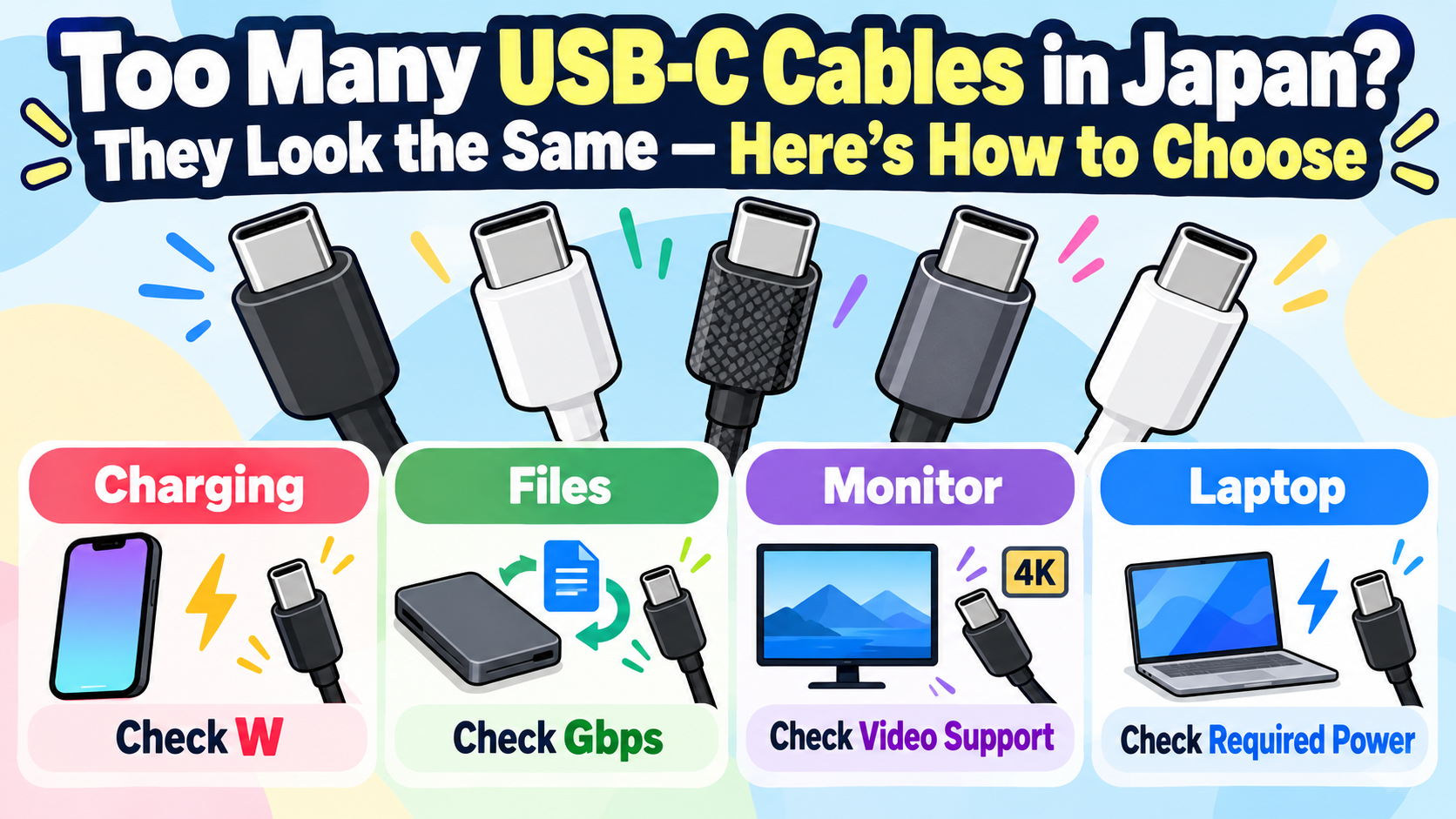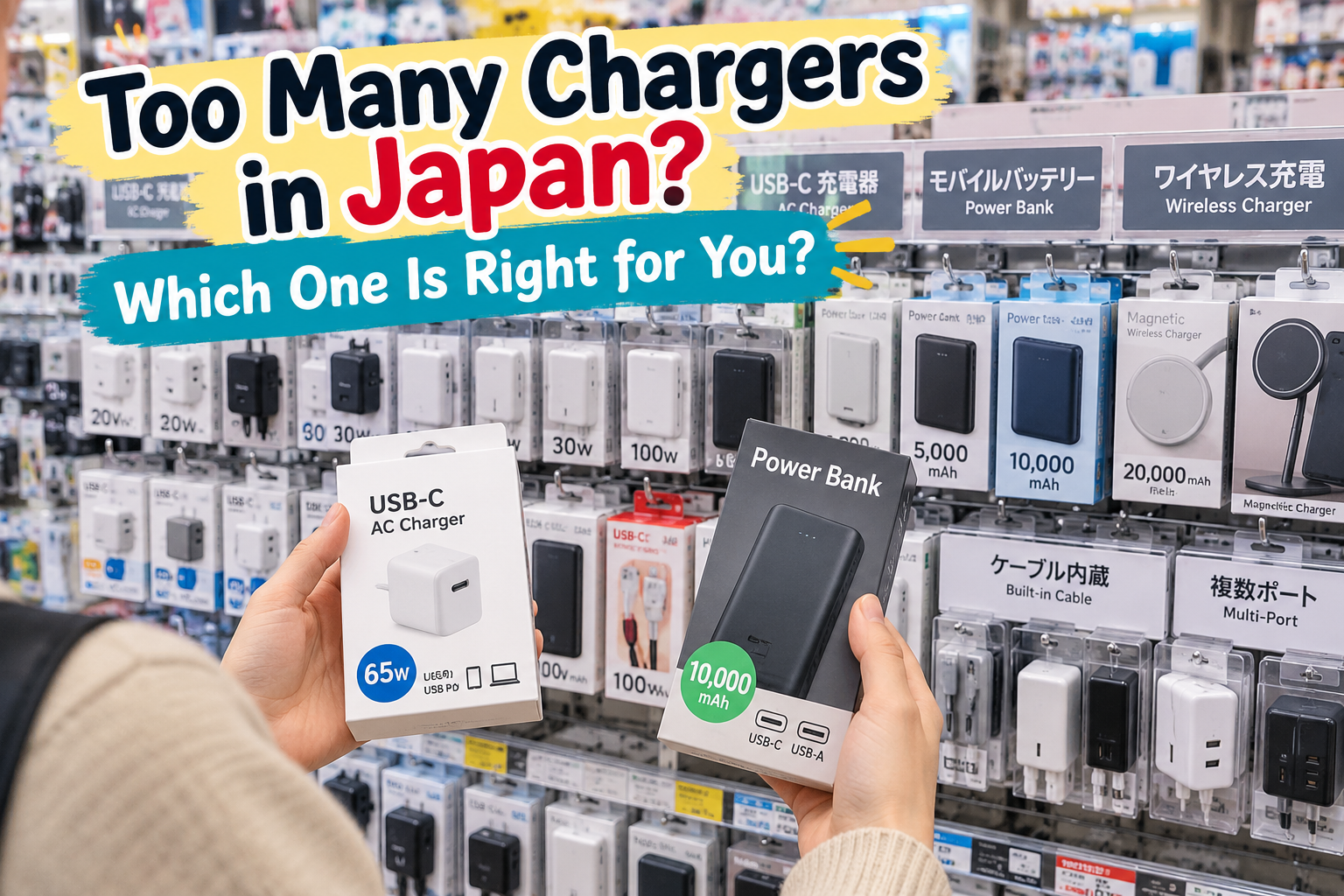
Walk into a Japanese electronics store and you may be surprised by how many chargers are on the shelves.
20W, 30W, 65W, USB-C, power banks, built-in cables, all-in-one chargers, magnetic chargers, wireless chargers, multi-port chargers…
You may find yourself wondering:
“Which one do I actually need?”
The charger with the most features or the biggest numbers is not always the best choice for you.
What matters is how you actually plan to use it.
Think about:
- What do you need to charge?
- Where will you use it?
- How many devices do you want to charge at once?
- Do you already have the right cable?
- Do you often forget cables or chargers?
- Does size or weight matter to you?
- Do you need to charge while you are out?
- Do you want to use it outside Japan later?
- Will you be taking a power bank on a flight?
This guide does not rank brands or tell you that one charger is best for everyone.
Instead, it helps you narrow down the type of charger that may suit your devices and travel style.
- Quick Guide: Which Type Might Suit You?
- 1. Start With What You Need to Charge
- 2. Already Have the Right Cable? You May Only Need the Charger
- 3. All-in-One Chargers Are More About Convenience Than Saving Space
- 4. Will You Charge at Your Hotel or While You Are Out?
- 5. What Does W Mean?
- 6. Multiple Ports Are Useful, but Check the Total Output
- 7. What Does mAh Mean on a Power Bank?
- 8. Magnetic Charging Can Be Convenient — but Think About Weight Too
- 9. Do You Really Need Wireless Charging?
- 10. Want to Use the Charger Outside Japan? Check INPUT
- 11. What Is the PSE Mark?
- 12. Flying After Buying a Power Bank? Check the Wh Rating
- Still Confused in the Store? Ask Yourself These Five Questions
- So, Which Charger Is Best?
- Disclaimer
Quick Guide: Which Type Might Suit You?
| Your situation | What to consider |
|---|---|
| You mainly charge your phone at your hotel | A small USB-C wall charger |
| You already have the correct cable | You may only need the charger itself |
| You need power while sightseeing | A power bank |
| You often forget cables | A built-in cable or all-in-one model |
| You use a phone and tablet | Check power output and number of ports |
| You also need to charge a laptop | Check your laptop’s charging requirements |
| You charge several devices at once | Check the number of ports and total output |
| You prefer charging without plugging in a cable | Wireless or magnetic charging may be an option |
| You want to use it outside Japan later | Check INPUT voltage and plug type |
| You will fly with a power bank | Check its Wh rating and your airline’s latest rules |
These are only general guidelines.
Charging requirements vary depending on your phone, tablet, laptop, and other devices.
1. Start With What You Need to Charge
Before comparing chargers, think about the devices you actually use.
Just a Smartphone
If you only need to charge one smartphone, you may not need a large, high-output charger.
A small USB-C wall charger may be enough for many phones.
However, charging requirements vary by model, so check the recommendations from your phone manufacturer if you are unsure.
A Smartphone and Tablet
A tablet may require more power than a smartphone.
If you want to charge both devices at the same time, a charger with two or more ports may be more convenient.
A Laptop Too
USB-C laptops can have very different charging requirements.
You may see chargers marked:
45W / 65W / 100W
But a larger number does not automatically mean that charger is right for your laptop.
Check the charging specifications recommended by your laptop manufacturer.
2. Already Have the Right Cable? You May Only Need the Charger
Japanese electronics stores sell many small wall chargers without a cable included.
If you already have a compatible cable, you may only need to buy the charger itself.
There is no need to buy another cable just because it is sold separately.
On the other hand, if you often think:
“I brought my charger, but I left the cable at the hotel.”
A model with a built-in cable may be easier for you to manage.
3. All-in-One Chargers Are More About Convenience Than Saving Space
Some products combine several functions.
For example:
- charger + cable
- power bank + cable
- wall charger + power bank
- multiple ports + built-in cable
An all-in-one design is not automatically better.
Its main advantage is usually convenience:
- fewer separate items to forget
- easier to keep everything together
- easier to grab when leaving your hotel
- useful when you suddenly need to charge something
It does not necessarily make your bag dramatically lighter or smaller.
If you are good at remembering your charger and cable separately, separate products may work just as well.
Choose whichever setup is easier for you to manage.
4. Will You Charge at Your Hotel or While You Are Out?
Where you plan to charge makes a big difference.
Mostly at Your Hotel or Accommodation
A small wall charger may be the simplest option.
If you already have a compatible cable, the charger itself may be all you need.
While Sightseeing or Traveling Around
A power bank may be useful if you are worried about your phone running low while you are away from a power outlet.
Travelers often use their phones heavily for:
- Google Maps
- translation apps
- photos and videos
- train directions
- digital tickets
- QR codes
That can use more battery than you expect.
If you need power when there is no wall outlet nearby, a power bank may be worth considering.
5. What Does W Mean?
Chargers often show numbers such as:
20W / 30W / 45W / 65W / 100W
W means watts and tells you about the charger’s power output.
But:
A bigger number does not automatically mean a better charger for you.
Your device also needs to support the charging method and power level.
You may also see USB PD, which stands for USB Power Delivery.
One important point:
USB-C does not automatically mean fast charging.
The charger, device, and sometimes the cable all need to support the appropriate charging standard.
If you are unsure, check the charging specifications provided by your device manufacturer.
6. Multiple Ports Are Useful, but Check the Total Output
A charger with two or three ports can be useful if you carry several devices, such as:
- a phone
- earbuds
- a smartwatch
- a tablet
- a laptop
But there is something important to check.
A charger may have 65W printed prominently on the package, but when several devices are connected at the same time, the available power may be divided between the ports.
So do not look only at the largest wattage number.
Also check the output specifications for simultaneous charging.
7. What Does mAh Mean on a Power Bank?
Power banks often show capacities such as:
5,000mAh / 10,000mAh / 20,000mAh
A higher mAh rating generally means the power bank can store more energy, but it may also be larger and heavier.
Instead of automatically choosing the biggest capacity, think about:
- how long you will be away from a power outlet
- what devices you need to charge
- how much weight you want to carry
The largest power bank is not always the most convenient one.
8. Magnetic Charging Can Be Convenient — but Think About Weight Too
You may also see chargers or power banks that attach magnetically to the back of a smartphone.
They can look similar, but they may work differently.
Magnetic Chargers That Need an External Power Source
Some magnetic charging pads do not contain their own battery.
They need power from a compatible USB power source or wall charger.
If you want to use one while you are out, you still need a source of electricity.
Magnetic Power Banks With a Built-in Battery
Other models contain their own rechargeable battery.
If the power bank itself is charged beforehand, it can charge your phone while you are outside without being connected to a wall outlet.
However, attaching a battery to the back of your phone can change how the phone feels in your hand.
You may notice:
- extra weight
- extra thickness
- a different grip
- hand fatigue during longer use
And remember:
When the power bank itself runs out of power, you need to recharge it.
On a longer trip, you may still need to carry a cable and charger to recharge the power bank.
So magnetic charging is not automatically the most convenient option.
Think about how you actually plan to use your phone.
9. Do You Really Need Wireless Charging?
Wireless charging can be convenient, but it is not necessary for everyone.
Before buying one, check:
- whether your phone supports it
- whether it works with your phone case
- whether a separate power adapter is required
- whether ordinary wired charging might actually be easier for you
More features do not always mean a better fit.
10. Want to Use the Charger Outside Japan? Check INPUT
If you plan to take the charger home and continue using it outside Japan, look at the charger’s INPUT information.
Some chargers support a wide voltage range such as:
100–240V
But specifications vary by product.
Also remember that even if the voltage is compatible, the wall plug shape may be different in your country.
Before buying, check:
- INPUT voltage
- supported voltage range
- plug shape
Do not assume that every charger sold in Japan can be used everywhere.
11. What Is the PSE Mark?
When looking at electrical products in Japan, you may notice a PSE mark.
PSE relates to Japan’s Electrical Appliances and Materials Safety Act.
For electrical products covered by the law, manufacturers or importers must meet applicable legal requirements before the PSE mark can be placed on the product and the product can be sold in Japan.
Power banks are among the product categories covered by Japan’s electrical product safety system.
The PSE mark can therefore be an important thing to check when buying a power bank in Japan.
However:
A PSE mark does not mean that an accident can never happen.
Also consider whether:
- the specifications are clearly shown
- the seller or responsible company is clearly identified
- warranty or support information is available
- the product has been recalled
- the battery shows any signs of damage or abnormal behavior
Do not continue using a power bank if you notice swelling, unusual heat, a strange smell, or other abnormal signs.
12. Flying After Buying a Power Bank? Check the Wh Rating
This is especially important for travelers.
A power bank that is useful during your trip may be subject to airline restrictions when you fly home.
Current rules in Japan place restrictions on how power banks can be carried on aircraft.
However, airline rules and international requirements can change, and some airlines, countries, or routes may apply different or stricter conditions.
So do not assume:
“This power bank should be fine on every flight.”
Before buying or flying:
- Check the Wh (watt-hour) rating on the power bank.
- Check the latest rules published by the airline you will actually fly with.
If you are flying with a Japanese airline, major airlines such as ANA and JAL provide current power bank information in English.
Always follow the latest rules published by your airline.
Still Confused in the Store? Ask Yourself These Five Questions
If the shelves still look overwhelming, start with these five questions.
1. What Am I Charging?
Just a phone?
A tablet too?
A laptop?
2. Do I Already Have the Right Cable?
If yes, you may only need a small charger.
3. Where Will I Charge?
Mostly at the hotel?
Or while I am out all day?
4. How Many Devices Do I Want to Charge at Once?
One?
Two or more?
If you have several devices, check both the number of ports and the total output.
5. What Is Inconvenient for Me?
Do you often forget cables?
Do you dislike carrying heavy items?
Do you want to avoid looking for a wall outlet?
Do you find it annoying to manage several separate charging accessories?
Once you know what actually bothers you, choosing becomes much easier.
So, Which Charger Is Best?
There is no single charger that is best for everyone.
Someone who only charges a phone at a hotel has different needs from someone who spends all day sightseeing with a power bank.
Someone carrying a laptop needs something different again.
An all-in-one charger may be convenient if you often forget cables.
A simple small charger may be better if you already carry everything you need.
A magnetic power bank may feel convenient to one person, while another person may dislike the extra weight and thickness.
And even a convenient power bank still needs to be recharged eventually.
The best charger is not the one with the most features.
It is the one that fits how you actually use your devices.
When you are standing in a Japanese electronics store surrounded by chargers, start by asking yourself:
Where will I charge, what will I charge, how many devices do I have, and how do I want to carry everything?
That alone can make the shelf much easier to understand.
Disclaimer
This article provides general guidance to help travelers compare chargers and power banks.
Charging requirements, supported standards, safety instructions, and compatibility vary by device and product.
Before purchasing or using a charger or power bank, check the official specifications and instructions provided by the manufacturers of your phone, tablet, laptop, charger, or power bank.
Rules for carrying power banks on aircraft may change depending on the airline, route, country, region, and date.
Always check your airline’s latest official information before traveling.